• F4
  • F1
  • F3
  • F2

Embroidered sampler dated 1756, The Netherlands (TRC 2020.3683).Embroidered sampler dated 1756, The Netherlands (TRC 2020.3683).At the end of August 2020 the TRC was given some early samplers following the sad death of Mw. Trees Verberne-Van Hamersveld, The Hague. She wanted to leave the samplers to the ‘Leiden Textile Museum’ (the TRC Leiden is often called this). We would like to thank Mrs Verberne-Van Hamersveld and her family.

There are a total of six samplers that date from between the mid-eighteenth century and 1803. They all have linen grounds and are worked in polychrome silk yarns, most of which have now faded. In addition, some of the black yarns have bled leaving heavy stains.

Three of the samplers are conventional forms with many motifs embroidered in cross stitch, although one of them also in includes letters and a date in eyelet stitch. The other three samplers are darning samplers.

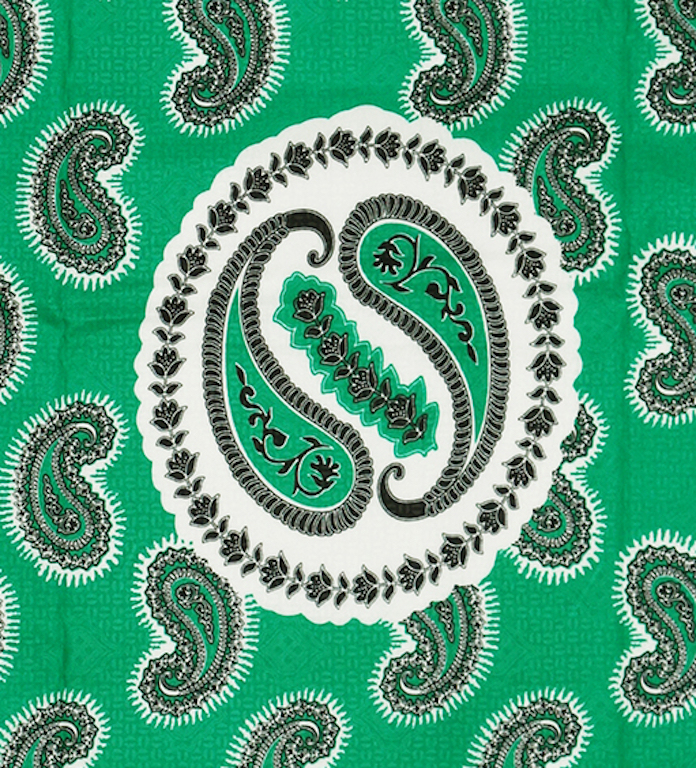
Women's jacket with printed Paisley motifs; The Netherlands, late 20th century (TRC 2016.1949).Women's jacket with printed Paisley motifs; The Netherlands, late 20th century (TRC 2016.1949).We are currently putting up the next TRC exhibition that is about textiles and clothing during WW2. It opens on the 16th September. But at the same time we are already working on the Paisley (buteh) exhibition, which was planned for the autumn of 2020, but because of the corona crisis was postponed to early 2021.

Part of the reason for actively working on Paisley/buteh motifs is that in October 2020 there will be a four-day online conference about the trade and movement of textiles in various parts of the world. It is being organised by the International Institute for Asian Studies in Leiden, in cooperation with the TRC and the Tracing Patterns Foundation in Berkeley, California.

One of the earliest surviving examples of a north European cross stitch sampler dates to the first half of the 16th century and is believed to come from Germany. It is now housed in in the Victoria & Albert Museum, London (T.114-1956). The sampler is made from an even weave linen ground and is embroidered in both cross stitch and long-armed cross stitch using silk yarns in various colours. Details about the sampler will be included in the forthcoming Encyclopedia of Embroidery, Vol. 3, which is being produced at the TRC in Leiden and will be published by Bloomsbury, London.

Late 19th century sampler worked by Johanna Alewijnse, from Zeeland in The Netherlands (TRC 2018.2380).Late 19th century sampler worked by Johanna Alewijnse, from Zeeland in The Netherlands (TRC 2018.2380).It is neither a great piece of art nor particular special. It is a sampler that was probably worked in the late nineteenth century by Johanna Alewijnse from Zeeland, The Netherlands (TRC 2018.2380). It's just school work, but with a surprise to those who turn it around.

The cloth measures 37 x 37 cm. It is made of a linen canvas, which was woven especially for teaching purposes, and it is embroidered with aniline dyed wool. The woollen embroidery thread is too thick for the (10-thread) mesh. The cross stitches form a thick mass, and the large squares are cushion-like and deform the fabric.

The layout is not very traditional. The sampler contains an alphabet and the beginning of a second, but there is no row of numbers. The letters are worked in the middle, rather than starting from the left. Above the alphabets is a row of squares with simple surface filling patterns, accompanied with other motifs, including baskets with flowers, animals, birds, and a star. Underneath the alphabets is a line of stylised flowers, a tree with paired birds, a male figure, and what appears to be a tea pot. All of this is framed by a simple border, which includes small geometric patterns in a seventeenth century style.

Women working a quilt under the 1930s WPA Sewing Room Project (Lee LC USF34 010885 D 768x573).Women working a quilt under the 1930s WPA Sewing Room Project (Lee LC USF34 010885 D 768x573).Last week the TRC took down its exhibition on American quilts. What became clear when organising and displaying the exhibition, is the importance that quilts have played in American history. A remarkable story is recounted by textile historian, Kyra Hicks, who tells about an Afro-American woman called Estella Weaver Nukes. She made a postage stamp quilt and presented it to President Roosevelt. TRC volunteer, Shelley Anderson, retells this fascinating story.

Before the US entered World War II, the country was struggling with massive unemployment and poverty. In an effort to provide jobs for millions of destitute Americans, President Franklin Delano Roosevelt (1882-1945) established the Works Projects Administration (WPA). The WPA hired jobless men to build roads, dams, schools and libraries.

Today is a day of mixed feelings! It is the last day of the American Quilt exhibition. We will take everything down tomorrow. The Gallery will be cleaned and we will then start putting up the next exhibition. A sad, yet exciting phase, as we say good-bye to a popular display, and build up something new.

Preparing the exhibition Textile Tales of the Second World War, TRC Leiden. Photograph by author.Preparing the exhibition Textile Tales of the Second World War, TRC Leiden. Photograph by author.

It is also a time to ponder on the 'fate' of the quilt exhibition, since it was closely linked to the spread of the corona virus. The exhibition was opened on 5th February by Marja Verloop, the depuy Chief-of-Mission of the American Embassy in The Hague. Lots of activities were planned, including lectures, workshops, quilt identification days, even a quilting week in May as part of the large Textile Festival held every five years in Leiden.

Unfinished sampler from the late 19th century, with aniline dyed embroidery threads (TRC 2020.2396).Unfinished sampler from the late 19th century, with aniline dyed embroidery threads (TRC 2020.2396).Some objects you do not keep just because they are attractive, but because they have a story to tell. One particular sampler in the TRC collection (TRC 2020.2396) is unfinished, the colours are garish and they have bled. If there was ever anything beautiful about it, it has completely disappeared. But we can really be glad that it has not been thrown away, because there is quite a lot to see.

Samplers were often left unfinished. Sometimes the girl was taken from school because her parents could no longer pay the fees, or because she had to work, or because she had to come home to help. Some girls died before they could complete their samplers. That would be a reason for the family to keep the cloth. It was a reminder of the deceased.

The TRC in Leiden has just finished a 1-day study day on the theme of ‘What is embroidery’ (29 July 2020) and a 5-day intensive textile course (17-21 August), which also included a session about the basic nature of embroidery. What is actually required to make a piece of embroidery? What tools are needed? Which stitches are used? When is this form of decoration actually carried out? And what is it used for, and how?

The general consensus was that (technically) embroidery is worked on a finished piece of material (whether it is woven, non-woven, leather, etc), using some form of yarn, with one or more stitches, worked with a needle, a hook or a similar tool.

Embroidered part of a woman's headdress from late 20th century Yemen (TRC 2015.0610).Embroidered part of a woman's headdress from late 20th century Yemen (TRC 2015.0610).

But there are always exceptions!

Zoek in TRC website

Contact

Boerhaavelaan 6
2334 EN Leiden.
Tel. +31 (0)71 5134144 (kantooruren)  
office@trcleiden.org

Het TRC is elke dag geopend tussen 10.00 en 15.00 uur.

facebook 2015 logo detail


instagram vernieuwt uiterlijk en logo


Bankrekening

NL39 INGB 0002 9823 59, t.a.v. Stichting Textile Research Centre.

Financiële giften

Het TRC is afhankelijk van project-financiering en privé-donaties. Al ons werk wordt verricht door vrijwilligers. Ter ondersteuning van de vele activiteiten van het TRC vragen wij U daarom om financiële steun:

Giften kunt U overmaken op bankrekeningnummer (IBAN) NL39 INGB 000 298 2359, t.n.v. Stichting Textile Research Centre. BIC code is: INGBNL2A

U kunt ook, heel simpel, indien u een iDEAL app heeft, de iDEAL-knop hieronder gebruiken en door een bepaald bedrag in te vullen: 


Omdat het TRC officieel is erkend als een Algemeen Nut Beogende Instelling (ANBI), en daarbij ook nog als een Culturele Instelling, zijn particuliere giften voor 125% aftrekbaar van de belasting, en voor bedrijven zelfs voor 150%. Voor meer informatie, klik hier