• F1
  • F4
  • F3
  • F2

New Look dress, late 1940's, early 1950's (TRC 2015.0030a-b).New Look dress, late 1940's, early 1950's (TRC 2015.0030a-b).The end piece of the TRC’s current exhibition “Textile Tales from the Second World War” is a beautiful, blue dress from the end of the 1940’s, early 1950's, which was made in The Netherlands (TRC 2015.0030a-b). The changes in women’s wear in the period, as impacted by the difficulties of the war and a renewed energy afterwards, are quite clear when looking at this particular garment and others on display.

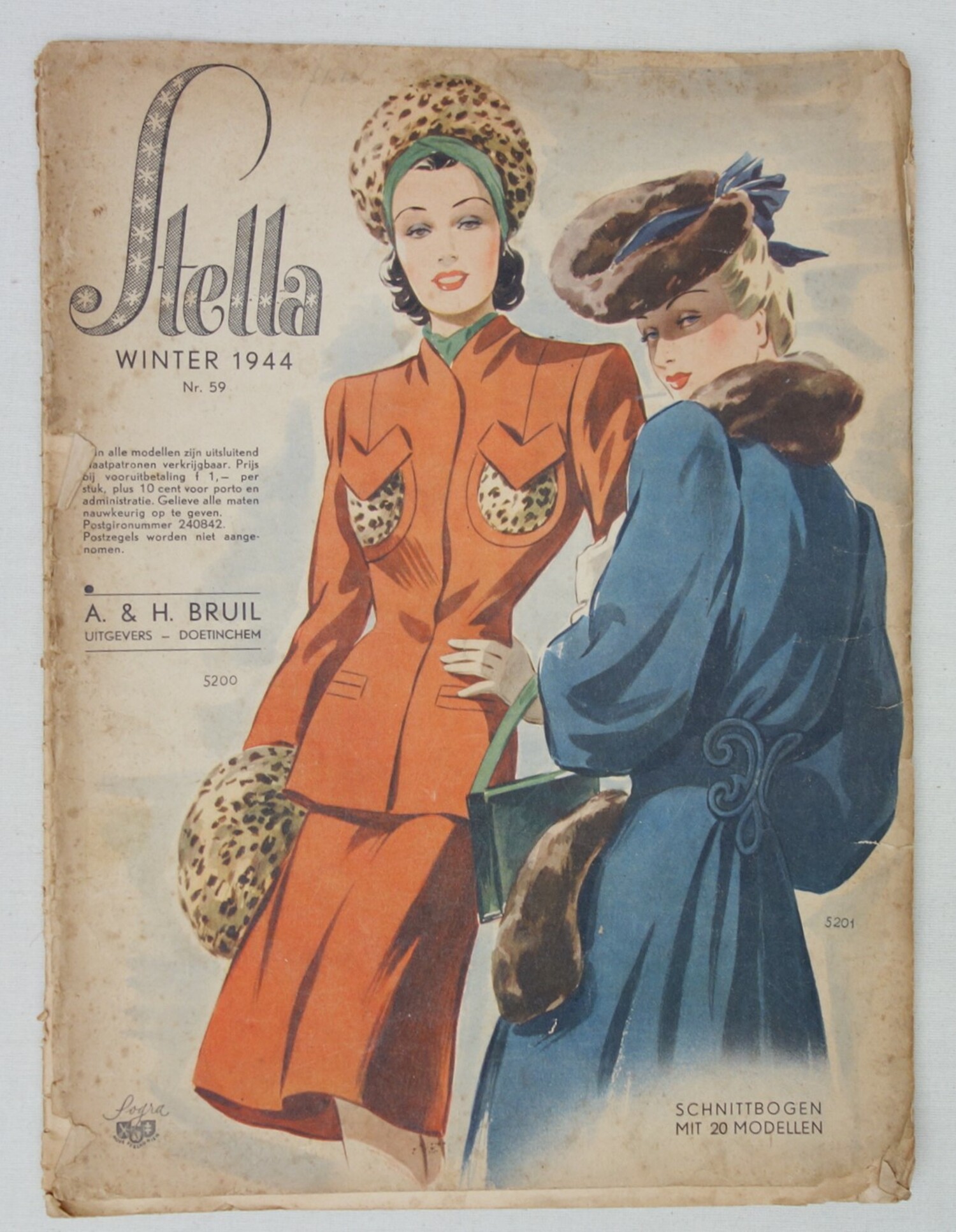
Rationing and fabric shortages led women to shorten their hemlines, re-use older dresses, wear tighter skirts or to forgo pockets (and sometimes even stockings) in an attempt to save on material.

Practicality overruled what had previously been seen as propriety. Reflective of the war as well in terms of style, some women’s jackets also tended to include padding and straight lines at the shoulders in an effort to emulate a military uniform’s style.

When looking at this specific blue piece from 1948 however, one will notice the rounder shoulder lines, pleating on the shoulders, the large collar and a fuller, long skirt that make it contrast with earlier wartime fashion.

The “extravagant” use of so much more material is indeed representative of renewed availability of resources after the end of the conflict. In fact, all these attributes are also rather reminiscent of the trend instigated by Christian Dior in France with his iconic New Look in 1947. Could this dress have been inspired by it? With its rounded curves and fuller, pleated skirt it could easily be argued that it was!

Detail of an Indian shawl with the buteh motif, 20th century (TRC 2017.1351).Detail of an Indian shawl with the buteh motif, 20th century (TRC 2017.1351).A lot has been written in recent years about cultural appropriation. We published a blog about this trendy concept some years ago (13th March 2016). Cultural appropriation, in brief, refers to the borrowing of a specific aspect of one culture and deliberately using it in one's own. It is about Europeans wearing a kimono, or people in Iceland wearing a sombrero.

I cannot, and could not take this discussion, which started in the US, too seriously; borrowing from other cultures has always been going on under the general term of adopt and adapt. Humanity would be very poor if people did not look beyond their own village. And I do enjoy a pizza, although I am not Italian.

Yet, last week I was confronted with what I would call a 'real' and indeed blatant example of cultural appropriation.

Like many people during the pandemic, I miss travelling. But the on-line conference Textiles On The Move (6-9 October 2020) has satisfied that craving. Researchers, experts and curators from around the world come together to explore the movement of textiles and garments in Asia, and between Asia and the rest of the world.

Modern example of Tissu Provencal with the paisley motif, ca. 2020 (TRC 2020.3192).Modern example of Tissu Provencal with the paisley motif, ca. 2020 (TRC 2020.3192).The online programme includes a series of presentations, video documentaries, guided tours, a round table discussion, with participants using chat boxes to ask questions after each session. The documentary on Minangkabau textiles and loom highlighted traditional skills that still have a local market. It was produced by the Tracing Patterns Foundation (Berkeley, Cal.), one of the conference organisers and a TRC partner.

I learned of many new resources, including the Washington, DC-based Cotsen Textile Traces Study Collection, which comprises some 4,000 fragments of textiles from Asia, the Middle East, Africa, Europe and the Americas.

Another resource is the Javanese Batik Collection of King Chulalongkorn of Siam, currently on display at the Queen Sirikit Museum of Textiles (Thailand). This includes over 300 beautifully preserved batiks dating from the 19th to early 20th centuries, with garments worn by royalty and (even rarer) by ordinary people. Many of the pieces were from batik ateliers run by Dutch women, like the mother-daughter team of W.F. van Lawick van Pabst, who created innovative designs mixing traditional Javanese skills with 19th century European motifs. The exhibition will be on display at the World Culture Museum in Sweden in 2021.

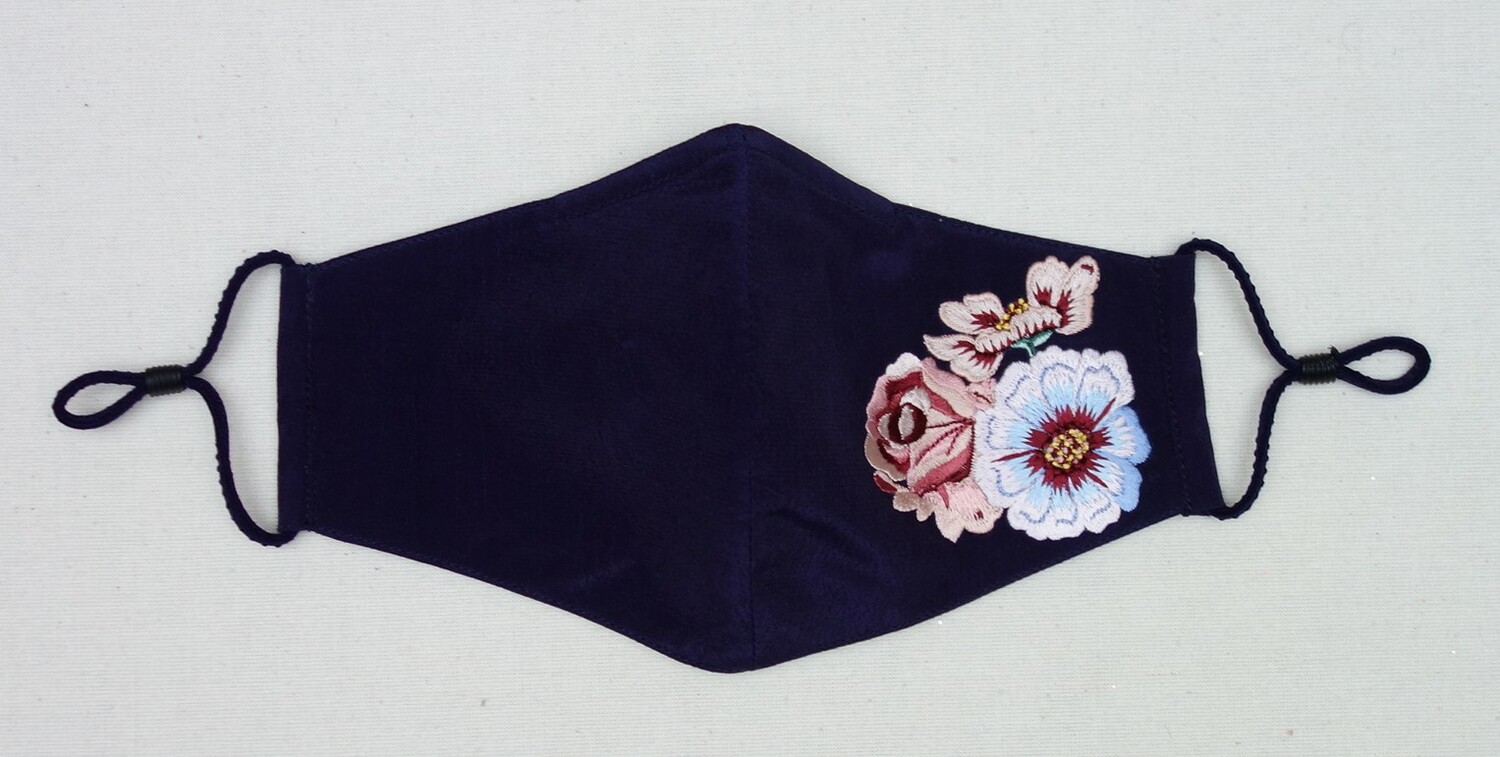
Tartan face mask with lacing for the Gothic/Punk market, China/UK, 2020 (TRC 2020.3997).Tartan face mask with lacing for the Gothic/Punk market, China/UK, 2020 (TRC 2020.3997).A little while ago TRC volunteer, Shelley Anderson, wrote a blog about a number of corona face masks that she had donated to the TRC Leiden, and describing them within the context of different social, economic, ethnic and cultural groups. One of the masks comes from Japan and is made from kimono material (TRC 2020.3771). Another one has a pattern of black and white stripes of a zebra. This mask originates from Kenya (TRC 2020.3759). There are also several ‘Black Lives Matter’ examples from the US (TRC 2020.3769).

Then I wrote a blog about the forthcoming paisley motif exhibition to be held at the TRC in the spring of 2021. In particular I talked about some Steampunk garments, notably a corset, shirt and coat, which we had acquired for the exhibition. These items were made from different forms of paisley cloth.

Length of African wax print, made in China, early 21st century (TRC 2020.3841).Length of African wax print, made in China, early 21st century (TRC 2020.3841).The TRC in Leiden recently acquired a piece of fabric for an upcoming exhibition on the Paisley motif (TRC 2020.3841). The green material sold as an African wax print or Ankara cloth, upon closer inspection, seems to be a poorly printed imitation of the original.

African wax prints are colourful fabrics, traditionally made in a similar fashion to batik, namely with wax resist printing. They are common to most African countries but more especially to West Africa. The printing technique of wax prints travelled from Indonesia through Dutch merchants to Africa.

There are some clues that led us to reconsider the provenance of this particular piece. The design is printed sideways and only on one side. Moreover, the paisley motif in the middle is surrounded by flowers more reminiscent of Chinese or Russian forms. More than that, on the selvedge (a part of African wax fabrics that usually carry the name of the company and quality of the cloth), a shoddily spelled text literally reads: “VERITABLE EMPEROR BATIC CLASSIC QUALITT ORER”.

Bridal dress worn by Giuseppina Mondelli in southern Italy, on 26 September 1926 (TRC 2020.3882a).Bridal dress worn by Giuseppina Mondelli in southern Italy, on 26 September 1926 (TRC 2020.3882a).The TRC in Leiden recently acquired a wedding dress that was worn in Italy on 26 September 1926. As with so many other textiles and garments, it is far more than a garment that was worn at a festive occasion many years ago. It unveils a family history that goes back for a hundred years, and in a wider context testifies to the sometimes tumultuous history of Italy in the 20th century. The blog is written by Francesco Montuori, a TRC volunteer who writes about his great-grandmother, whose wedding dress is now a precious item in the TRC Collection (TRC 2020.3882a).

"This wedding dress used to belong to my great-grandmother, Giuseppina Mondelli (1900-1980). She was born in Sannicandro, a small village close to Bari, in southern Italy, and was my grandmother’s mother, on my father’s side.

Carding and combing at the September 2020 edition of the five-day TRC Intensive Textile Course. Photograph: Augusta de Gunzbourg. The author of this blog is sitting to the left.Carding and combing at the September 2020 edition of the five-day TRC Intensive Textile Course. Photograph: Augusta de Gunzbourg. The author of this blog is sitting to the left.I am still recovering from the Intensive Textile Course at the TRC in Leiden! What a week!

As a researcher at the Rijksdienst van het Cultureel Erfgoed (Cultural Heritage Agency of the Netherlands), I am often confronted with small pieces of textiles, sometimes from an archaeological context.

I analyse a few fibres taken from the textile with an electron microscope (SEM) to study their condition and whether they have been dyed or stained. These small pieces and fibres are, of course, part of a larger piece of cloth! But what does the resulting information actually tell us about the larger cloth, the previous owner, what was the original colour (s) and how was the cloth used?

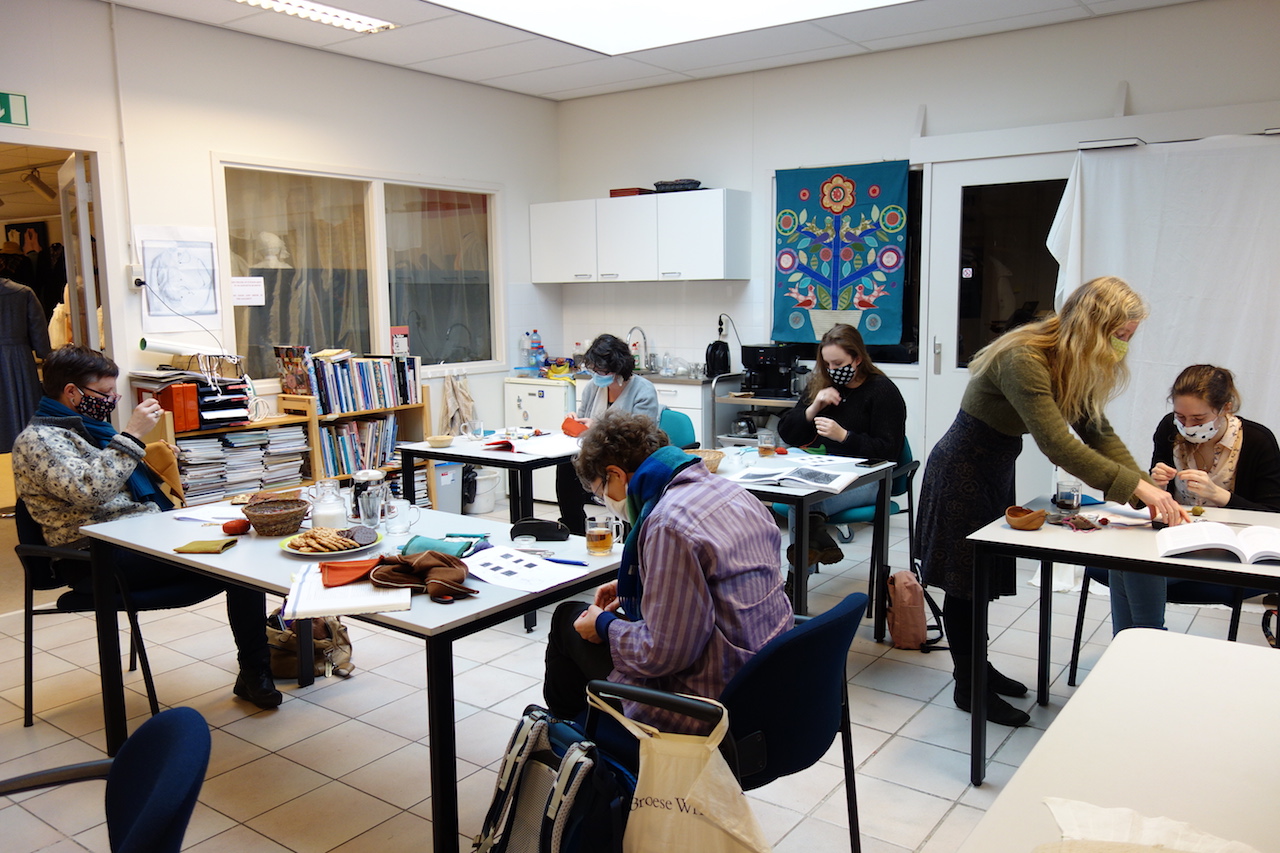
To gain more insight into textiles in general, I registered for the five-day Intensive Textile Course at the TRC. Under the inspiring supervision of the director of the TRC, Gillian Vogelsang, we identified fibres, we spun them into threads and we used weave frames to turn threads into cloth. Because of the corona virus we did so in a small group with six people, which enabled us to spend more time on practising and discussing the various techniques.

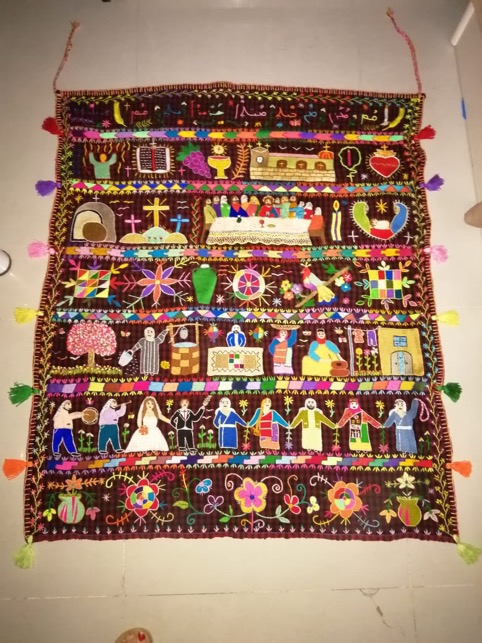
Maria Friesen talking at the TRC in Leiden about Mennonite comforters, 26th Sept. 2020. Photograph by Lynn Kaplanian-Buller.Maria Friesen talking at the TRC in Leiden about Mennonite comforters, 26th Sept. 2020. Photograph by Lynn Kaplanian-Buller.Last Saturday, 26th September, eight of us gathered at the TRC in Leiden under Gillian Vogelsang’s warm guidance and hospitality, to hear Maria Friesen’s presentation on ‘Passing on the comfort received in the past”. Maria's presentation, which was preceded by a brief introduction to the TRC by Gillian, has been filmed to share among anyone interested, and the film will soon be made available.

Maria Friesen is the coordinator of the European comforter groups that donate their comforters (relief quilts) to the Mennonite Central Committee (MCC). She came from Switzerland to tell us about how the most recent comforter-making project evolved among Mennonite initiators in Switzerland and spread to more groups in Europe.

In order to create a context, she told us about the history of the Mennonite Central Committee, which was founded 100 years ago. During her talk, Maria included many photographs that she had collected for the official celebrations, which unfortunately had to be cancelled because of the corona pandemic.

Zoek in TRC website

Contact

Boerhaavelaan 6
2334 EN Leiden.
Tel. +31 (0)71 5134144 (kantooruren)  
office@trcleiden.org

Het TRC is elke dag geopend tussen 10.00 en 15.00 uur.

facebook 2015 logo detail


instagram vernieuwt uiterlijk en logo


Bankrekening

NL39 INGB 0002 9823 59, t.a.v. Stichting Textile Research Centre.

Financiële giften

Het TRC is afhankelijk van project-financiering en privé-donaties. Al ons werk wordt verricht door vrijwilligers. Ter ondersteuning van de vele activiteiten van het TRC vragen wij U daarom om financiële steun:

Giften kunt U overmaken op bankrekeningnummer (IBAN) NL39 INGB 000 298 2359, t.n.v. Stichting Textile Research Centre. BIC code is: INGBNL2A

U kunt ook, heel simpel, indien u een iDEAL app heeft, de iDEAL-knop hieronder gebruiken en door een bepaald bedrag in te vullen: 


Omdat het TRC officieel is erkend als een Algemeen Nut Beogende Instelling (ANBI), en daarbij ook nog als een Culturele Instelling, zijn particuliere giften voor 125% aftrekbaar van de belasting, en voor bedrijven zelfs voor 150%. Voor meer informatie, klik hier