• F3
  • F2
  • F4
  • F1

Last month, Gillian and I made a quick dash to southern France to see various dear friends. We first went to visit Mohammad Khairzada, who together with his wife and children found a safe haven in France some years ago when the Taliban took control of Afghanistan. Khairzada studied with us in Leiden in 2007-2008, and returned to his country to conduct various archaeological excavations in and around Kabul, among other places at the famous Buddhist site of Mes Aynak. I regularly met him again at the Dutch embassy in Kabul and elsewhere when I worked in Uruzgan, in the south of the country, between 2008 and 2011.

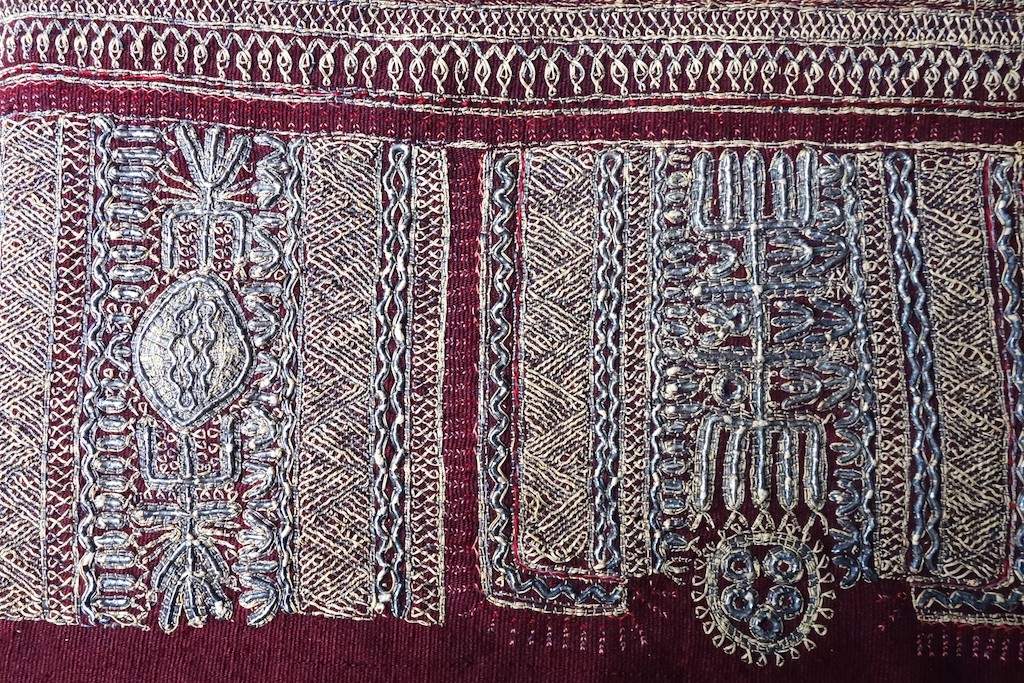
We also went to see Joanne and Luc Aujame, who have a beautiful farmhouse just outside of Lyon. Luc lived in Kabul as a child, many years ago, together with his parents. His father, Roger Aujame, and his mother, Edith Schreiber-Aujame, were architects and urban planners who worked in the Afghan capital from 1961-1965. Some time ago, Luc and his wife donated a large number of Afghan garments to the TRC, including textiles and other objects from Nuristan (Fig. 1), formerly known as Kafiristan, east of Kabul. They also gave the TRC a large number of scans of colour photographs taken in Afghanistan in the early 1960s.

Fig. 1. Prayer mat from Nuristan, Afghanistan, 1960s (TRC 2022.1936). Aujame Family donation.Fig. 1. Prayer mat from Nuristan, Afghanistan, 1960s (TRC 2022.1936). Aujame Family donation.

Fig 1: First impression of the Vasa ship. The picture does not do justice to the sheer size of this beauty. Photograph by author.Fig 1: First impression of the Vasa ship. The picture does not do justice to the sheer size of this beauty. Photograph by author.During a trip to Stockholm I visited the Vasa ship museum. This place highlights a spectacularly preserved Swedish warship Vasa that sank in 1628. You're faced with the massive ship front as soon as you walk in and it is absolutely breathtaking (Fig 1).

Because the ship was wrongly weighted it never made it out of the bay, sinking only minutes after its departure. The ship is preserved in its entirety and was carefully dredged out of the sea in the 1960s, conserved, and placed into the Vasa museum.

Fig 2: Showcases in front of the ship with preserved jackets, buttons (very similar in style to TRC 2024.2729 and TRC 2024.2618), brocaded fabric, shoes and mittens. Photograph by author.Fig 2: Showcases in front of the ship with preserved jackets, buttons (very similar in style to TRC 2024.2729 and TRC 2024.2618), brocaded fabric, shoes and mittens. Photograph by author.The museum beautifully highlights the textile finds from this site (see Fig 2). Underwater archaeology is a keen interest of mine as it is one of the few ways organic material can be preserved. So items such as textile, leather and wood that would usually long since have decayed often remain.

Items from the 17th century at the TRC are really limited to some velvet coths and buttons, but I realised while visiting just how much I understood about these items due to my time at the TRC.

Pashtun woman's wedding outfit, prepared for 360-photography. Photograph by author.Pashtun woman's wedding outfit, prepared for 360-photography. Photograph by author.The TRC and Modemuze collaborated on a project last week during which a selection of ten outfits/objects from the TRC Collection were photographed from all angles, to generate an online, 360-degrees image. Modemuze is a fascinating platform connecting different museum collections from across the Netherlands and Belgium, aiming to tell the stories about all these objects of Fashion.

On our side, clothing from a wide variety of countries were selected to give an insight into the diversity of our pieces: India, Pakistan, Afghanistan, Yemen, Japan, Germany, Morocco, the Netherlands and Palestine. As the curator on call, I was to help decide on the selection of pieces and mount them on mannequins to be photographed.

Each item was fitted on a mount, and set up meticulously on a turn-table in front of a backdrop. Then, as the turntable rotated the object, a camera would photograph it from every angle.

I recognised them straight way when going through the TRC collection: bindi stickers (TRC 2014.0519). As a child, I used to stick them on my forehead during dress-up parties with friends. I knew they were something Indian, but my understanding did not go much further than that. Now, seeing them again at the TRC, in a completely different context, I find myself curious about what they actually mean.

Bindi set from India. Early 21st century. TRC 2014.0519.Bindi set from India. Early 21st century. TRC 2014.0519.

Besime Alikisioglu, Master's student at Leiden UniversityBesime Alikisioglu, Master's student at Leiden UniversityAs a Museum Studies master’s student from Turkey, at Leiden University, I was overwhelmed when I saw the large Turkish collection recently donated to the Textile Research Centre (TRC) in Leiden (for two previous blogs on the subject, see 9 June and 2 July). I felt a mix of excitement, amazement, and emotion. I was impressed by the variety and the care taken with the items.

Born and raised in Istanbul, I grew up visiting Topkapı Palace and the Istanbul archaeological museums, a habit that continued during my years as an Art History student. The collection felt like drawing a historical chronology, each garment a fragment of Anatolia’s layered past, stitched with memories of Ottoman heritage, rural traditions, and shifting borders.

What struck me most was the incredible range of objects included, garments, jewellery, and çarık (leather shoes), not only from Turkey but also from surrounding regions such as Syria, Armenia, and even Central Asia, reflecting the deep interconnection of cultures across time and space. This was not just a donation of fabric and fibre; it was a gift of memory, craftsmanship, and identity, and it resonated deeply with my own academic and personal journey.

Fig. 1. TRC interns ctaloguing Turkish garments recently donated to the TRC (photograph by author).Fig. 1. TRC interns ctaloguing Turkish garments recently donated to the TRC (photograph by author).Followers of the TRC blogs will know that we have collected a first group of a large collection of Turkish garments donated to the TRC. Since then, a group of volunteers and students have been busy tagging, registering, and photographing the garments (see previous blog).

The theme of the collection is the Ottoman Empire, which covered, at its height, a vast area including Southeast Europe, West Asia, North Africa and parts of the Arabian Peninsula, from about 1299 until 1919. It still has an influence, beyond Turkey, on the material culture of much of the Middle East and parts of Eastern Europe, especially the Balkan region.

The first group, which we collected three weeks ago, included women’s outfits from Beypazari, Balikesir, Eskişehi, Keles, Konya and Seyi. The first 233 items are now online and there are many more pieces to be added to the database over the next month or so.

Last Thursday (26 June), as participants of the TRC’s 5-day Intensive Textile Course were making their own samples of velvet, we had the honour to welcome Dian Oerip, with her son, together with Nova Burdo-Marseline (Fig. 1).

They had been looking for the ‘Textile Museum’, which is listed by Google Maps as being on the Hogewoerd here in Leiden! What Google means is of course the TRC. They were initially disappointed that the TRC is not a museum, and that currently there are no exhibitions for the public to see (this is not the first time that visitors to the city have come looking for the Leiden Textile Museum!).

Fig. 1. Surprise visit of Indonesian weaver at the TRC Five-day Intensive Textile Course, June 2025Fig. 1. Surprise visit of Indonesian weaver at the TRC Five-day Intensive Textile Course, June 2025

Recently some very interesting objects arrived at the TRC, kindly donated by Jasja Kotterman and family. As an intern at the TRC, I was asked to enter the objects into the TRC collection catalogue, tagging them and entering details, such as materials, country of origin, and techniques. Sometimes part of our work for the catalogue is also to identify what, exactly, the item is and how it is used. At times, such as in the case of these new objects, this involves looking deeper into their social and cultural significance and history under the TRC focus of ‘dress and identity’.

Fig. 1. Tibetan saddle rug (TRC 2025.0765a).Fig. 1. Tibetan saddle rug (TRC 2025.0765a).

Zoek in TRC website

Contact

Boerhaavelaan 6
2334 EN Leiden.
Tel. +31 (0)6 28830428  
office@trcleiden.org

Het TRC is elke dag geopend tussen 10.00 en 15.00 uur.

facebook 2015 logo detail


instagram vernieuwt uiterlijk en logo


Bankrekening

NL39 INGB 0002 9823 59, t.a.v. Stichting Textile Research Centre.

Financiële giften

Het TRC is afhankelijk van project-financiering en privé-donaties. Al ons werk wordt verricht door vrijwilligers. Ter ondersteuning van de vele activiteiten van het TRC vragen wij U daarom om financiële steun:

Giften kunt U overmaken op bankrekeningnummer (IBAN) NL39 INGB 000 298 2359, t.n.v. Stichting Textile Research Centre. BIC code is: INGBNL2A

U kunt ook, heel simpel, indien u een iDEAL app heeft, de iDEAL-knop hieronder gebruiken en door een bepaald bedrag in te vullen: 


Omdat het TRC officieel is erkend als een Algemeen Nut Beogende Instelling (ANBI), en daarbij ook nog als een Culturele Instelling, zijn particuliere giften voor 125% aftrekbaar van de belasting, en voor bedrijven zelfs voor 150%. Voor meer informatie, klik hier