• F4
  • F3
  • F2
  • F1

The TRC is very proud to announce the publication of the fourth volume of Bloomsbury's World Encyclopedia of Embroidery:  Embroidery from Scandinavia and Western Europe, composed under the aegis of the Textile Research Centre (TRC), Leiden, The Netherlands. Authors: Gillian Vogelsang-Eastwood and Willem Vogelsang.

This is the first reference work to describe the history of embroidery throughout Scandinavia and Western Europe from the Bronze Age to the present day. It offers an authoritative guide to all the major embroidery traditions of the region and a detailed examination of the material, technical, artistic and design aspects of the subject, including its modern-day uses.

For millennia, the peoples of Scandinavia and Western Europe have been producing domestic and professional embroidery to decorate themselves, their families, clients, homes and public spaces.

Detail of dress ‘Sahraouia gandoura’ by Kenza Bennani, New Tangier, 2024. Photograph by Christina de Korte.Detail of dress ‘Sahraouia gandoura’ by Kenza Bennani, New Tangier, 2024. Photograph by Christina de Korte.The exhibition MODA: Moroccan Fashion Statements at the Centraal Museum in Utrecht (in collaboration with DAR Cultural Agency) includes artists and designers from Morocco and the Moroccan diaspora in the Netherlands. The title of the exhibition, moda, is the Moroccan-Arabic word for fashion (from French: mode).

The exhibition is divided into several themes, such as ‘Monumental’, ‘Cosmopolitan’, ‘Amazigh Hair Heritage’, ‘Friendship’, and ‘Artists & Artisans’.

An interesting element of this exhibition, and one of the common themes, are the photographs that are spread throughout the exhibition, originating from residents from Utrecht, visitors to the museum, and the participants of the MODA exhibition. In addition, all the exhibition texts are displayed in Dutch, English, and Arabic, with some titles even in Tamazight.

Portrait of Jane Austen, wearing a chemisette, from the memoir by J. E. Austen-Leigh (1871), based on a sketch by Cassandra Austen.Portrait of Jane Austen, wearing a chemisette, from the memoir by J. E. Austen-Leigh (1871), based on a sketch by Cassandra Austen.In an earlier TRC blog, attention focussed on a 19th century, Western urban garment, namely a pair of detachable sleeves known as engageantes. The blog was written because there are various mid-19h century examples in the TRC collection.

Thanks to a donation of a large collection of needlework and related garments by the Naaldkunst Museum, Winschoten, in October 2023, the TRC now has several examples of another, even more intrguing garment from the mid-19th century, namely chemisettes.

But what exactly is a chemisette? According to the Concise Oxford English Dictionary, since 1807 a chemisette is regarded as: … (1) “a bodice, more or less like the upper part of a chemise”, and (2) “an article, usually of lace or muslin, made to fill in the open front of a woman’s dress”.

The word chemisette is the diminutive of the Old French (and hence Middle English) word, chemise, which in its turn comes from the late Latin camisia, meaning a shirt or nightgown (compare also Arabic qamiz).

More specifically, the (English) term chemisette refers to a garment that has the appearance of the front, back and neckline of a blouse or shirt, but without side sections. It was worn underneath a garment that was open at the front, but it added little bulk to the complete outfit.

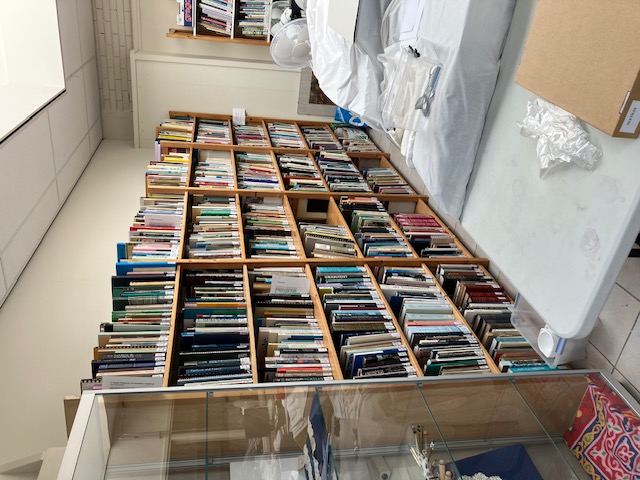
The TRC Collection is growing in depth and breadth and is attracting more and more people and groups.

Christina de Korte, TRC intern, talking with a team from the textile printing firm of Vlisco visiting the TRC, Tuesday 3 December 2024. Photograph by TRC. Christina de Korte, TRC intern, talking with a team from the textile printing firm of Vlisco visiting the TRC, Tuesday 3 December 2024. Photograph by TRC.

Yesterday, for example, we had a visit by a design group from the famous Dutch textile printing company of Vlisco, which is particularly known for the production of “wax hollandais”. This is a form of printed cloth that was developed by the firm in Helmond, the Netherlands, over 160 years ago and which is geared to West and Central African tastes.

by Christina de Korte, TRC intern from Utrecht University, 25 November 2024

Khayamiya is an Egyptian appliqué technique that is often used for tents for different occasions, such as iftar during Ramadan, weddings and funerals. Originally, khayamiya was handmade, by applying fabric pieces onto a ground cloth, but nowadays it can be produced with various techniques, which result in various shapes. Although khayamiya is very recognisable, the scenes and depictions have been changing throughout time.

Detail of a khayamiya door panel with Arabic calligraphy of Q 48:4 in Thuluth script, Egypt, late 20th century (TRC 2024.1544).Detail of a khayamiya door panel with Arabic calligraphy of Q 48:4 in Thuluth script, Egypt, late 20th century (TRC 2024.1544).

With all the people here at the TRC, or via other friends, we can usually identify the textiles and garments that come in. There was a description in a previous blog, for example, of textiles that might be church pillar hangings (TRC 2024.2934a-b). There were also rectangular shapes that turned out to be humeral veils (TRC 2024.3061) that are worn by Roman Catholic priests as a form of shawl, over a chasuble.

But ever so often we get an object that flummoxes us, so we have decided to have a new series of blogs called ‘What is it’? The first ? item (TRC 2024.3109) came in a few days ago and is part of a donation of textiles and garments that originate from as far apart as Guatemala and Indonesia and were donated by Marjolijn van Scherpenzeel (Hartendief, Leiden).

Large rectangle with a central panel of green silk velvet edged with black, red and grey silk velvet and framed by a band of yellow diagonal lines in surface couching (TRC2024.3109).Large rectangle with a central panel of green silk velvet edged with black, red and grey silk velvet and framed by a band of yellow diagonal lines in surface couching (TRC2024.3109).

Pim Arts, curator Dordrechts Museum, visiting the TRC to  inspect the recent donation of liturgical vestments. Photograph by Herra Pahlasari.Pim Arts, curator Dordrechts Museum, visiting the TRC to inspect the recent donation of liturgical vestments. Photograph by Herra Pahlasari.by Christina de Korte, intern at the TRC from Utrecht University, 9 November 2024

In the last couple of weeks, visitors to the Textile Research Centre (TRC) in Leiden could see two clothing racks filled with colourful silk chasubles, dalmatics, and other types of liturgical vestments, which were donated by Marjolijn van Scherpenzeel (Hartendief, Leiden). These items are intriguing on various levels, for example, from a technical perspective, looking at the production methods of the garments, or from an art historical viewpoint, focussing on the pattern design, but also with particular attention for the religious usage of the textiles. As a student of religious studies, I was excited when these items arrived, especially because my main research focus is on textiles that are used in religious settings.

On the 31st October 2024, curator and researcher Pim Arts (Dordrechts Museum) came to the TRC to discuss these new TRC items and to provide more historical and social context. Pim has extensive knowledge about liturgical vestments and has curated, among other events, the exhibition Fashion for God at the Museum Catharijneconvent (2023) in Utrecht. The exhibition focused on liturgical outfits in clandestine Catholic churches in the (Protestant) north of the Netherlands from the late sixteenth to the early nineteenth century. An important element in the exhibition was the recycling of textiles, and this aspect also plays an prominent role in the importance of the recent donation.

Egyptian khayamiya door panel (late 20th century) (TRC 2024.1544). Photograph author.Egyptian khayamiya door panel (late 20th century) (TRC 2024.1544). Photograph author.My name is Christina de Korte, and I am a visual artist and currently a second-year research master student in Religious Studies at Utrecht University, specializing in the intersection between textiles, art, and (material) religion. From September 2024 until mid-December 2024, I am an intern at the TRC.

From September 2022 until April 2023, I lived in Egypt for eight months to learn the Egyptian Arabic dialect, study Egyptian art(ists) and textiles, and follow various courses about local techniques. I fell in love with khayamiya, a textile that is omnipresent in Egypt.

Zoek in TRC website

Contact

Boerhaavelaan 6
2334 EN Leiden.
Tel. +31 (0)6 28830428  
office@trcleiden.org

Het TRC is elke dag geopend tussen 10.00 en 15.00 uur.

facebook 2015 logo detail


instagram vernieuwt uiterlijk en logo


Bankrekening

NL39 INGB 0002 9823 59, t.a.v. Stichting Textile Research Centre.

Financiële giften

Het TRC is afhankelijk van project-financiering en privé-donaties. Al ons werk wordt verricht door vrijwilligers. Ter ondersteuning van de vele activiteiten van het TRC vragen wij U daarom om financiële steun:

Giften kunt U overmaken op bankrekeningnummer (IBAN) NL39 INGB 000 298 2359, t.n.v. Stichting Textile Research Centre. BIC code is: INGBNL2A

U kunt ook, heel simpel, indien u een iDEAL app heeft, de iDEAL-knop hieronder gebruiken en door een bepaald bedrag in te vullen: 


Omdat het TRC officieel is erkend als een Algemeen Nut Beogende Instelling (ANBI), en daarbij ook nog als een Culturele Instelling, zijn particuliere giften voor 125% aftrekbaar van de belasting, en voor bedrijven zelfs voor 150%. Voor meer informatie, klik hier