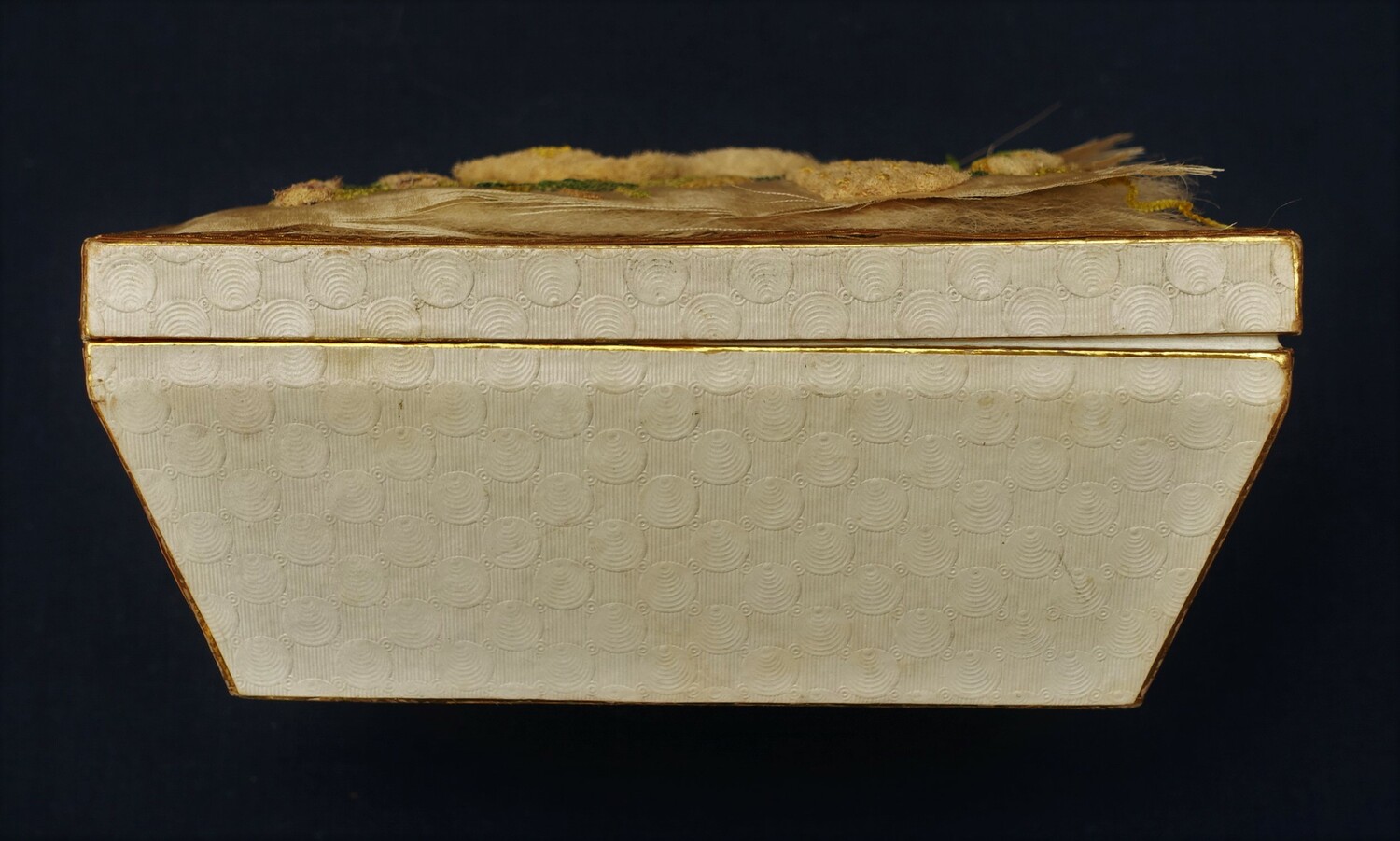
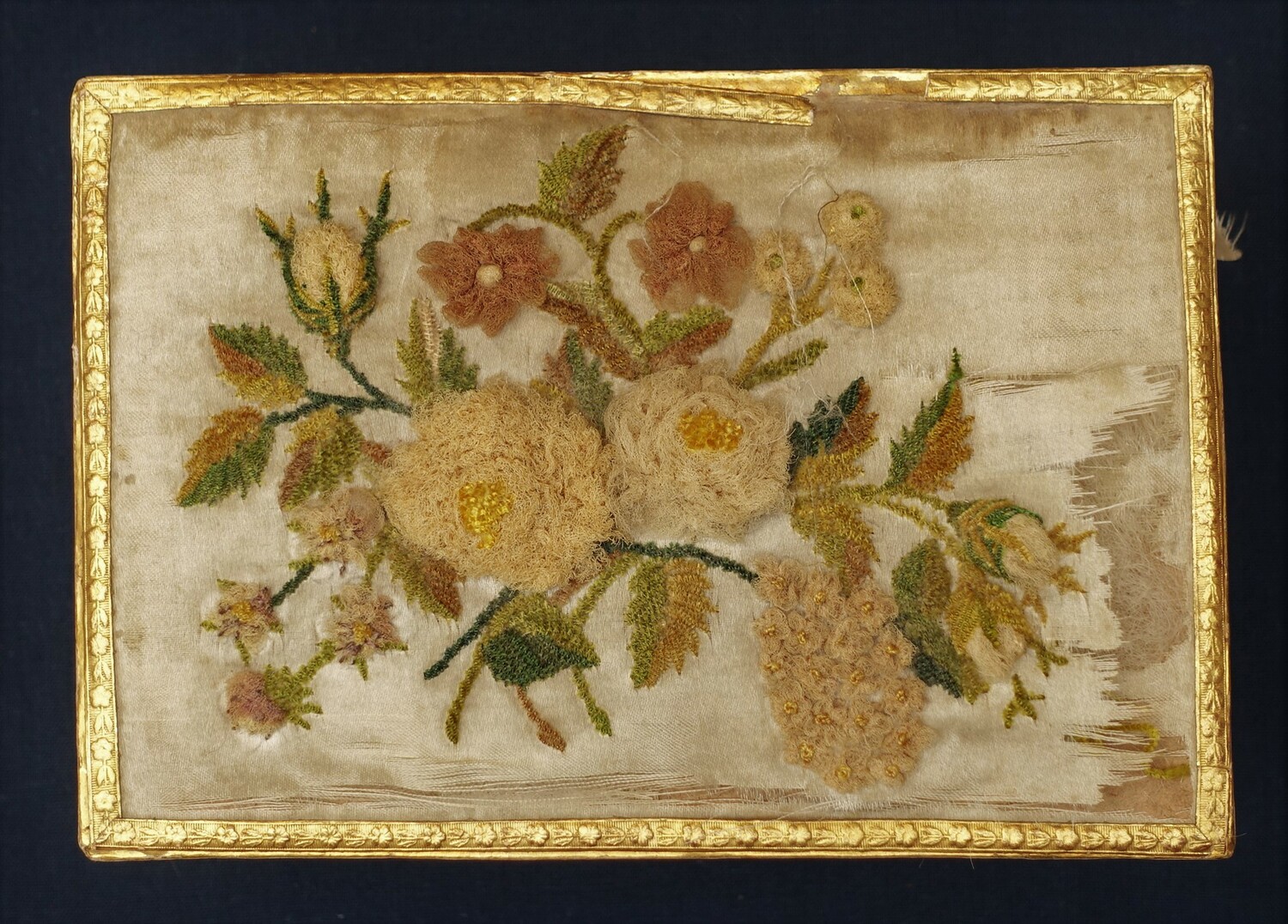
• F4
  • F2
  • F3
  • F1

A few months ago the TRC was given a face mask that is hand painted with an image of a girl and an elephant in a landscape setting (TRC 2021.2484). It is signed Fabrice and has the title: "ZoZo". The face mask was made by the Dutch artist Fabrice Hünd and donated to the TRC by friends of the artist, Monica Penders and her son Jirka, who a few weeks ago also bought some hand painted Christmas tree baubles directly from the artist.

On New Year's Day we received the sad news that he had died the day before, on New Year's Eve, at the age of sixty. 

Face mask designed and hand painted by Fabrice Hünd, 2021 (TRC 2021.2484).Face mask designed and hand painted by Fabrice Hünd, 2021 (TRC 2021.2484).

Collar and label for a man's jacket by the French tailoring house of Maison R. Cumberland / F. Disslin, mid-1930s (TRC 2021.3360a).Collar and label for a man's jacket by the French tailoring house of Maison R. Cumberland / F. Disslin, mid-1930s (TRC 2021.3360a).This week I started researching some of the latest additions to the TRC collection (TRC 2021.3360a-c; 3361a-b; 3362; 3363). They came as a set made up of seven pieces, accredited to the tailoring house of Maison Cumberland, Paris, including two dinner jackets, two tailcoats (one morning, one dress) and one waistcoat.

They were acquired by a Dutch gentleman in the mid-1930s. The name of the owner is written on one of the labels (C.A. Wiessing). The garments are indicative of a unique cultural period that occurred during the 19th and early 20th century.

Gathering information on the Maison Cumberland has proven challenging, with many details lost through time - it’s been satisfying to find traces of its former success left behind in advertisements, postal addresses and historical literature. The popularity of British tailoring reflects the hegemony of the British Empire during its height in the 19th century, dominating popular fashion trends both across the Channel and throughout the world.

Waistcoat, Maison R. Cumberland, Paris, dated 16 May 1935 (TRC 2021.3360b). The label indicates the waistcoat was made for Mr C.A. Wiessing.Waistcoat, Maison R. Cumberland, Paris, dated 16 May 1935 (TRC 2021.3360b). The label indicates the waistcoat was made for Mr C.A. Wiessing.Prior to this, in the 18th century, France had taken the stage as the global fashion powerhouse. However, the French Revolution gave Britain’s tailoring industry a chance to develop, fuelled by the limited contact between France and Britain during the Napoleonic Wars. This expansionist moment is well articulated in an excerpt from a speech given by Conservative MP John Wheeler to the British parliament on the 5th of November 1987 regarding Savile Row, the traditional centre of British high class men's tailoring.

‘Given the nature of our hostile climate, tailoring has been a feature of our country for some time. We all like to wear clothes… it was the French Revolution that gave the British tailor the opportunity to lead men's fashion’.

The garments now accessed in the TRC Collection should thus be understood as a visual signifier of the influence of power seeping into fashion, the human trait of copying those who are in control and of the reach of the British Empire to places both near and far.

British tailors were also sought after due to their association with the British royal family and 'upper class' living. In this period, demand for British tailoring peaked in Paris, heralding a period of British tailoring houses opening across the city. A good example, apart from the Maison Cumberland, is the House of Worth, established in Paris in 1858 by Charles Frederick Worth.

Dress called 'Les vases communicants' with the virtually transparent 'Tears & Lace' pattern, designed by the Darquer lace manufacturer for the Elsa Schiaparelli fashion house (2015). The design is based on the work of the photography artist, Rose-Lynn Fisher.Dress called 'Les vases communicants' with the virtually transparent 'Tears & Lace' pattern, designed by the Darquer lace manufacturer for the Elsa Schiaparelli fashion house (2015). The design is based on the work of the photography artist, Rose-Lynn Fisher.When I read the recent TRC blog about Elsa Schiaparelli, I thought of the exhibition The Art of Lace (2020) in the TextileMuseum in Tilburg. This exhibition, adapted from an earlier exhibition called 'Haute Dentelle' mounted in Calais in 2018, was an ode to lace manufacturers, but also to the fashion houses that use lace.

The exhibition did not focus on handmade lace, but on machine made forms. The laces for the fashion industry were often specially designed and made for the couture houses. Lace factories, such as those of Solstiss in Caudry and Darquer Méry and Noyon Dentelles in Calais, still exist.

A number of Elsa Schiaparelli's dresses, with lace, were displayed in this exhibition. Schiaparelli's fashion house used different lace manufacturers. One of the dresses was made of lace and reflected a special story:

Gillian Vogelsang of the TRC Leiden and Bärbel Schmidt of Osnabrück University in the TRC depot, 30 November 2021.Gillian Vogelsang of the TRC Leiden and Bärbel Schmidt of Osnabrück University in the TRC depot, 30 November 2021.At the end of November, and just before the Netherlands went into lockdown again, we welcomed two visitors from the Textile Department of Osnabrück University in Germany, namely Prof. Bärbel Schmidt and her colleague, Lucia Schwalenberg (for a TRC blog about this visit, click here).

We discussed co-operation between our two institutes, talked about the future of textile studies in general and we selected sixteen garments (eight German and eight Dutch), which our German visitors are borrowing. The garments are for a project with the German BA students in Osnabrück to create designs and objects that are inspired by these items of clothing. I am very curious what they will create!

The TRC was not the only venue visited. Bärbel and Lucia were on a four-day trip to see various museums, exhibitions and people in the Netherlands and Belgium. They have written a report about their trip which is available here.

Embroidered panel with flowers, birds, and animals, South Africa, early 21st century (TRC 2021.0189). Embroidered panel with flowers, birds, and animals, South Africa, early 21st century (TRC 2021.0189). 2021 has been such a strange year, open, shut, open, postpone, expand, talk, share, mutter mightily, people going into quarantine, and making plans for the future. It has all been happening, sometimes everything at the same time or so it has felt! I have been asked on various occasions ‘What word characterises the TRC?’ After this year it's simple: ‘flexibility’, the ability to change and adapt to changing circumstances, to greet visitors, photograph textiles, discuss ongoing research, and wash the tea and coffee cups, while enjoying what we are doing and why. 2021 has shown that flexibility at all levels is essential!

We have been fortunate that there have been several, very generous donations that have meant the TRC Leiden not only survived 2020 and 2021 and all the havoc caused by the various waves of the Covid19 virus, but unexpectedly we have actually thrived. The closures have meant we have had time to work on the collection, including cataloguing, photography and putting objects away. In 2021, for example, a total of 4259 items were added to the collection. As a result there are now nearly 37,000 items online and open to everyone to learn from and be inspired by.

Schiaparelli’s famous 1927 sweater, now on display in the Mode Museum, Paris.Schiaparelli’s famous 1927 sweater, now on display in the Mode Museum, Paris.Intrigued by some recent TRC blogs about clothes and Princess Diana, I’ve been reading more about designers of haute couture. The V&A (London) has done everyone a service by reprinting the autobiographies of influential fashion designers such as Paul Poiret, Christian Dior, Ernestine Carter and Norman Hartnell, among others.

The list includes my personal favourite, the wildly inventive Elsa Schiaparelli (1890-1973). Her zest for life and quirky sense of humour shine throughout her autobiography, appropriately titled Shocking Life (and perhaps a nod to her invention of the term “shocking pink”). This was a woman who experimented with unusual fabrics and materials, such as plastics, glass and ceramics; who created buttons in the shape of large bugs or stars; and who collaborated with creative geniuses like Jean Cocteau, Man Ray and Salvador Dali.

She was also a late bloomer, who started her career at the age of 35, from a cramped atelier on Paris’s Left Bank (she slept in a room above the atelier, where the rats kept her awake at night). Her first hit was in 1927. It was a sweater, with a modernist bow, hand knitted by Armenian emigrants in the downstairs atelier. Five years later she had eight ateliers and was turning out almost 8,000 garments.

Chest panel for a woman's outfit from the island of Marken, the Netherlands, hand painted in the style of Indian chintz, mid-20th century (TRC 2010.0493). Chintz cloth (called sits in Holland) was imported, and then exported, in large quantities from India from the 17th century, influencing local Dutch clothing, such as that from the Frisian town of Hindelopen and the island of Marken. Chest panel for a woman's outfit from the island of Marken, the Netherlands, hand painted in the style of Indian chintz, mid-20th century (TRC 2010.0493). Chintz cloth (called sits in Holland) was imported, and then exported, in large quantities from India from the 17th century, influencing local Dutch clothing, such as that from the Frisian town of Hindelopen and the island of Marken. Although we are in lockdown it does not mean the TRC is silent! Far from it. We are working on numerous plans and ideas to make 2022 a memorable year for all textile lovers and friends of the TRC. Our plans include many more workshops, courses, events such as book fairs, open weekends, Q&A days, and of course various large exhibitions in the TRC Gallery. Many of these events are organised against the backdrop of the Leiden: Euopean City of Science 2022 programme.

In addition, one of our long-term projects is to create and display a series of mini-exhibitions. We have a suitable showcase in the workroom (deliberately placed there and not in the main Gallery, so that the story is separated from the main exhibitions), in which individual objects or groups of small items can be displayed for one to two months. The mini-exhibition is not limited to showing some objects with text boards, but will also entail a series of online blogs that present the objects and provide extra information.

The mini-exhibitions reflect one of the basic philosophies of the TRC, namely framing objects within their social and cultural context. In other words, the aim is to tell the stories behind the objects. Some stories will be about individual people, others about the objects themselves, sometimes they will be technical stories, on other occasions they will be more personal accounts.

Embroidered postcard from France, early 20th century (TRC 2015.0435).Embroidered postcard from France, early 20th century (TRC 2015.0435).Exactly thirty years ago, on 19th December 1991, the Textile Research Centre (TRC), Leiden, was officially established as a Stichting (Foundation) under Dutch law.

We had planned to have a party since we felt that this significant milestone should be noted and celebrated, but due to the corona crisis, this has had to be postponed.

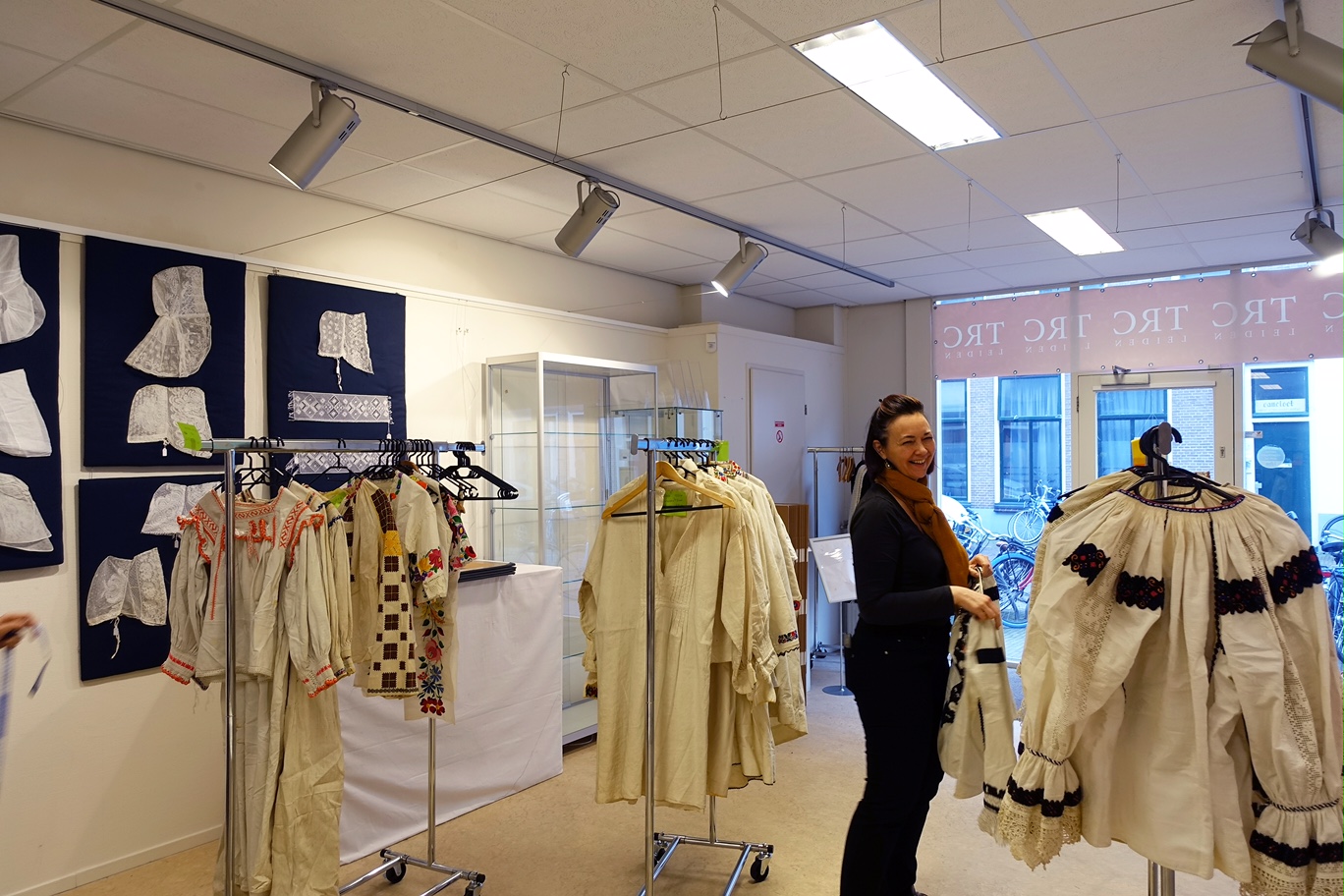
From the beginning the TRC has been an educational centre with an emphasis on the passing on of knowledge about textile techniques and the concept of dress identity. Throughout the years we have stressed the importance of textile crafts and artisanship. We have also been involved with many different cultures and groups. Our extensive collection (now some 37,000 objects, most of which are accessible online) from around the world and from all ages is continually used in the many workshops and courses that the TRC is organising. Textiles should not only be seen, but also be touched, smelled and even listened to!

Zoek in TRC website

Contact

Boerhaavelaan 6
2334 EN Leiden.
Tel. +31 (0)6 28830428  
office@trcleiden.org

Het TRC is elke dag geopend tussen 10.00 en 15.00 uur.

facebook 2015 logo detail


instagram vernieuwt uiterlijk en logo


Bankrekening

NL39 INGB 0002 9823 59, t.a.v. Stichting Textile Research Centre.

Financiële giften

Het TRC is afhankelijk van project-financiering en privé-donaties. Al ons werk wordt verricht door vrijwilligers. Ter ondersteuning van de vele activiteiten van het TRC vragen wij U daarom om financiële steun:

Giften kunt U overmaken op bankrekeningnummer (IBAN) NL39 INGB 000 298 2359, t.n.v. Stichting Textile Research Centre. BIC code is: INGBNL2A

U kunt ook, heel simpel, indien u een iDEAL app heeft, de iDEAL-knop hieronder gebruiken en door een bepaald bedrag in te vullen: 


Omdat het TRC officieel is erkend als een Algemeen Nut Beogende Instelling (ANBI), en daarbij ook nog als een Culturele Instelling, zijn particuliere giften voor 125% aftrekbaar van de belasting, en voor bedrijven zelfs voor 150%. Voor meer informatie, klik hier