• F2
  • F4
  • F1
  • F3

In 2020 the TRC received six samplers from Mrs. Trees Verberne-Van Hamersveld, The Hague (for more information, click here). One of them was an interesting darning sampler, TRC 2020.3687, dated to 1765, making it more than 250 years old. The large ‘nine patch’ in the centre and the many cross stitch motifs between the darning blocks make it rather unusual for a Dutch darning sampler. So what is it, and who made it?

Sampler dated 1765, Leiden?, worked in a Roman Catholic context (TRC 2020.3687).Sampler dated 1765, Leiden?, worked in a Roman Catholic context (TRC 2020.3687). 

Title page of Olfert Dapper's Naukeurige beschrijving ... (Amsterdam 1672).Title page of Olfert Dapper's Naukeurige beschrijving ... (Amsterdam 1672).Last weekend I was browsing through a 17th century Dutch encyclopedia about Mughal India (as one does in the weekends), and to my surprise I came across a rather detailed account of the production and use of Kashmir shawls. Having a closer look at the text  and doing some Googling I found out that the Dutch text was almost a verbatim translation of information contained in the work of a French physician and traveller, François Bernier (1620-1688).

I had known about the French record, and ploughed through it a long time ago, but the passage about Kashmir shawls had obviously escaped me. It often amazes me how much information and knowledge about Asia was available in Europe, and in particular in the Netherlands in the 17th century. In this case, his information about the Kashmir shawls I had missed completely; I am sure others writing about Indian textiles or Kashmir shawls in particular, will know about it, but still, many seem to have missed it as well. It remains fascinating, for me, to read these early details in a Dutch publication of the 17th century.

Bernier visited Kashmir in 1664-1665, and his report, Histoire de la dernière Revolution des États du Grand Mogol .... appeared in 1670 and 1671, while a more complete version, in 2 volumes, called Voyages dans les États du Grand Mogol was published in 1699, in Amsterdam, and abain in 1724. Other editions in various languages were published for many years.

We are sometimes asked how a particular object found its way to the TRC Collection in Leiden? Who are the donors? How do people hear about the TRC? Sometimes it is very simple and there is direct contact, or a parcel arrives in the post. On other occasions it can be a little more convoluted and involves the help of various people in different parts of the world.

Let me give you an example. A few weeks ago, 28 December, we published a blog by Shelley Anderson about the French designer, Elsa Schiaparelli (1890-1973) and her fashion house.

Sample of the 'Tears & Lace' design, Darquer & Méry, Calais, France  (TRC 2022.0003a).Sample of the 'Tears & Lace' design, Darquer & Méry, Calais, France (TRC 2022.0003a).

For the last year the TRC Leiden has been cooperating with the indomitable Yasmine El Dorghamy, who is the editor of RAWI: Egypt’s Heritage Review series, based in Cairo, Egypt. More specifically, we have been working together on vol. 11 of the series, with the title: Egypt’s Costume History (2021). The project was supported by the Drosos Foundation and a grant from the Dutch Embassy in Cairo. 

Cotton quilt with a  Flower and Berries motif, USA, 1850s (TRC 2019.2402).Cotton quilt with a Flower and Berries motif, USA, 1850s (TRC 2019.2402).One of the oldest quilts (TRC 2019.2402) in the TRC collection dates to before the American Civil War (1861-1865). It’s a beautiful quilt in a Flowers and Berries motif, with nine large hand-appliquéd blocks, and is dated to c. 1850. In a blog article from 7 April 2020, TRC quilt specialists Susan Cave and Beverley Bennett argue that the quilt was very likely made by an enslaved woman, not for herself, but for the white family who owned her.

I have often wondered about this unknown woman. Was she proud of the beauty she created, of her obvious skill as a needle woman? Or did she hate this work as just one more task she was forced to do for a family not her own?

Length of 'George' cloth from Nigeria, 20th century (TRC 2019.1361).Length of 'George' cloth from Nigeria, 20th century (TRC 2019.1361).I am coming to the final stages of writing the third volume of the Bloomsbury World Encyclopadia of Embroidery, which is about embroidery from sub-Saharan Africa. Not surprisingly there is a list of things that need to be checked, added or thrown out.

One of the items on the list is a type of cloth called ‘George’, which has been described as embroidered cloth that is used among the Igbo people of Nigeria. It would appear that during the 20th century this type of cloth became more and more popular among a much wider group in Nigeria and among Nigerians living elsewhere in the world. Most Nigerians realise the cloth comes from India, but what exactly is it?

Looking in various books, articles and online items, including Nigerian shops selling George cloth, it became clear there is no consensus concerning what exactly George cloth is. Some of it is described as ‘plain George’, other forms as ‘fancy George’. There are also checked (tartan, plaid) Georges with embroidered squares, a plain George with gold coloured thread woven into it, as well as an embroidered George with floral motifs using sequins and mirrors.

Wedding photograph of Monica Hoogstraate and Wim Penders, 1966. The groom is wearing jacket TRC 2021.3360c.Wedding photograph of Monica Hoogstraate and Wim Penders, 1966. The groom is wearing jacket TRC 2021.3360c.Often the biography of a garment is even more interesting than its material, decoration or technique.

A few months ago the TRC received a set of seven garments. They were donated by Monica Penders, daughter of the modern art dealer, Will Hoogstraate, who founded the Galerie D’Eendt in Amsterdam in 1960.

Monica’s husband, for their wedding in 1966, was given suitable clothing by an acquaintance, the son (Frans Wiegers) of the Dutch expressionist painter, Jan Wiegers (1893-1959). These are the clothes now in the TRC collection.

Wearing expensive clothing for one's wedding obtained from someone else seems to be a Dutch 'thing': I wore my father's jacket and waistcoat that he wore at his wedding in 1943, when I got married deep in the Dales of Yorkshire in 1985 (both garments now in the TRC Collection, TRC 2010.0078a)!

But back to the seven garments: they were already discussed in a previous TRC blog by Erica Prus, who focused on the tailoring house that made them in the mid-1930s, according to the labels sewn onto the clothing, namely the Maison Cumberland / F. Disslin, at 3, Rue Scribe and 66, Avenue Victor-Emmanuel III, in Paris.

All of this information set me off on a bit of detective work. Who was the first owner, and how did the clothes end up at a 1966 wedding in Amsterdam?

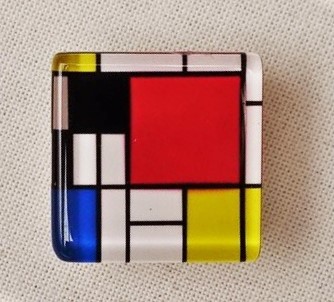
Dress displayed at the exhibition 'Vogue Paris, 1920-2020,' based on a painting by the Dutch artist, Piet Mondriaan. Photograph by S. Anderson.Dress displayed at the exhibition 'Vogue Paris, 1920-2020,' based on a painting by the Dutch artist, Piet Mondriaan. Photograph by S. Anderson.The pandemic has meant living in my sweatpants and bathrobe. Perhaps because of this, a visit to an exhibition at the Palais Galliera (officially known as the Musée de la Mode de la Ville de Paris) has increased my appreciation for haute couture.

The exhibit, called Vogue Paris, 1920-2020, celebrates the centennial of the French edition of the fashion magazine Vogue. Founded by Condé Nast in 1920, Vogue Paris is the oldest French fashion magazine still in publication—and the only Vogue that includes the name of a city rather than a country.

It was fascinating to learn about the magazine’s history, especially during the Second World War. The magazine was among the first that was refused permission to publish by the German occupiers, who had searched Vogue’s offices and studio. For an article on how Vogue in England and America aided the Allied war effort, click here.

The first post-war issue, only five months after Paris was liberated, included work by Picasso and Colette. The editors of the magazine were determined to rebuild the city’s reputation as the world capital of culture, devoting thirty pages of each issue, not to fashion, but to the arts.

Zoek in TRC website

Contact

Boerhaavelaan 6
2334 EN Leiden.
Tel. +31 (0)6 28830428  
office@trcleiden.org

Het TRC is elke dag geopend tussen 10.00 en 15.00 uur.

facebook 2015 logo detail


instagram vernieuwt uiterlijk en logo


Bankrekening

NL39 INGB 0002 9823 59, t.a.v. Stichting Textile Research Centre.

Financiële giften

Het TRC is afhankelijk van project-financiering en privé-donaties. Al ons werk wordt verricht door vrijwilligers. Ter ondersteuning van de vele activiteiten van het TRC vragen wij U daarom om financiële steun:

Giften kunt U overmaken op bankrekeningnummer (IBAN) NL39 INGB 000 298 2359, t.n.v. Stichting Textile Research Centre. BIC code is: INGBNL2A

U kunt ook, heel simpel, indien u een iDEAL app heeft, de iDEAL-knop hieronder gebruiken en door een bepaald bedrag in te vullen: 


Omdat het TRC officieel is erkend als een Algemeen Nut Beogende Instelling (ANBI), en daarbij ook nog als een Culturele Instelling, zijn particuliere giften voor 125% aftrekbaar van de belasting, en voor bedrijven zelfs voor 150%. Voor meer informatie, klik hier