• F2
  • F3
  • F1
  • F4

A few weeks ago Gillian and I visited the former island of Schokland, in the middle of what is now the Noordoostpolder, but until 1932 an island in the Zuiderzee, some 4 km long and 100-400 m wide. It is a weird and intriguing place, rising up a few metres above the completely flat, surrounding lands that used to be the bottom of the sea. A church, a few houses and a visitors’ centre crown the highest point of the island.

Oil painting of Schokland, by Hermanus Koekkoek (1815-1882). Public domain.Oil painting of Schokland, by Hermanus Koekkoek (1815-1882). Public domain.

Schokland was a fairly prosperous island in the 17th and 18th centuries, with some agriculture, a fishing industry and provisions for ships from all around the Zuiderzee that anchored along its shores. By the late 18th century, there were some 600 people living on the island, in three higher areas connected by narrow sand ridges.

The island of Schokland and its church from the east.The island of Schokland and its church from the east.However, by the early 19th century agriculture had virtually disappeared because of the surrounding lands being flooded by the sea, the fishing industry was in decline, and other means of making a living were slowly disappearing. The flood of 1825 was particularly damaging to the island. The people of Schokland were some of the poorest in the Netherlands, and national fundraising was organised to financially support them.

Extremely cold winters and storms sealed the fate of the island’s habitation, and by 1859 all of its people were evacuated, leaving the island virtually deserted until included in the Noordoostpolder. In 1995 the former island was declared to be a UNESCO World Heritage site.

In the local shop on the island we found a little booklet published in 2007 by Pieter Korver, De calicotsweverij van Schokland 1839-1858 (ISBN 90-72380-92-0). It tells the story of a partly commercial, partly governmental initiative in the first half of the 19th century to provide a living for the people on Schokland by introducing small-scale textile production. A detail in the history of textiles that is virtually forgotten nowadays, even in the Netherlands.

Regional dress of Schokland. Engraving published in 1857. Public domain.Regional dress of Schokland. Engraving published in 1857. Public domain.By the early 19th century, the British textile industry had virtually taken over the export of cotton cloth (calico: unbleached, plain weave cotton cloth named after the city of Kozhikode in southwestern India) to the Dutch East Indies (Indonesia). To counter this development, the Dutch started their own cotton weaving industry in the Netherlands. They did so in areas with high unemployment where weavers could work from home.

However, the ‘weavers’ first had to learn to weave, especially with the flying shuttle, which had been in use in Britain for quite some time after its introduction in 1733. Weaving schools were set up, where men, women and children were taught how to weave with the new looms, and afterwards they were engaged in the cottage industry. The company provided the looms and yarns (mainly from England) and they paid for the textiles that had been woven.

This initiative was also introduced on the island of Schokland. Two weaving schools were financed and established by the government on two of the habitation centres of the island, looms were installed, and mainly young people, boys and girls, were taught to weave the calicot fabric. As with other weaving schools in the Netherlands, the weaving schools on Schokland soon became weaving centres, subsidised by the government, where the weavers could work; this was often much easier and efficient than working from home.

The church of Schokland and the (restored) sea ddefences. Photograph Willem Vogelsang, May 2021.The church of Schokland and the (restored) sea ddefences. Photograph Willem Vogelsang, May 2021.The calico weaving on the island only lasted for some twenty years. The two buildings used for the weaving regularly had to be repaired, sometimes because of the bad weather, but also because of the continuous movements of the looms causing vibrations that shook the buildings.

Furthermore, in the winter the provision of yarns and other goods often came to a halt and weaving had to be stopped. In addition, the price of the finished products was continuously reduced because of the fierce competition on the world market.

In the end, the cottage industry simply could not compete with the industrialized production elsewhere. In 1852, the first steam-driven weaving workshop in the Netherlands was established that further diminished the economic viability of hand woven cloth.

As a result, in 1858, the Dutch government decided that there was no future for the people on the island, and orders were given for everyone, more than 600 inhabitants, to leave. Many went to the city of Kampen on the mainland, where a separate neighbourhood was built for them; others moved to different places along the Zuiderzee. After their departure from Schokland, most of the houses and other buildings on the island were removed and/or taken down. Only one of the original churches remained.

Willem Vogelsang, 30 June 2021.

Small bag with woven designs from Peru, c. 2020 (TRC 2021.2073).Small bag with woven designs from Peru, c. 2020 (TRC 2021.2073).While looking around the historic city of Maaseik in northeastern Belgium last week prior to going to see the Anglo-Saxon embroideries in the Sint Catharina church (see blog), Willem and I met Seppe Bleukx and his Peruvian wife, Venessa. They had set up a small stall selling Peruvian textiles inside a florist shop cum café. They have been helping a group of weavers in Peru who are badly affected by the lack of customers, local and tourists, in Peru.

Small bag with woven designs from Peru, c. 2020 (TRC 2021.2071).Small bag with woven designs from Peru, c. 2020 (TRC 2021.2071).So the Family Bleukx are selling a range of bags and textiles made by the weavers in pop-up stalls in various parts of Belgium. We have bought three small bags for the TRC Collection (TRC 2021.2071, TRC 2021.2072 and TRC 2021.2073) and we are now wondering if we can help them by stocking the bags in the TRC Shop.

This is the story of VeinteVeinte as told by Seppe Bleukx and his wife Venessa:

VeinteVeinte or 20-20 in Spanish is a number which many people associate with a time of twists and changes. Despite what happened in 2020, VeinteVeinte for us represents a new start. The start of a new relationship between Peru and the world. I moved to Peru many years ago and met there Vanessa, who was born and raised in Cusco, the old Inca capital, and home to Machu Picchu.

Small bag with woven designs from Peru, c. 2020 (TRC 2021.2072).Small bag with woven designs from Peru, c. 2020 (TRC 2021.2072).Over time we realised how much interest there is in unique, Peruvian handicrafts and accessories. When my sister Griet came to Peru last year, we felt that we must do something with this geographical and emotional connection and VeinteVeinte was born. Now, several months and lockdowns later, the time is ready for us to present our initiative to a much wider audience.

Basically, VeinteVeinte offers carefully selected handmade Peruvian gifts and goods such as textiles, bracelets, bags, purses, and blankets. We purchase everything directly from the people responsible for making these colourful items and in doing so deliberately cut out middlemen. This allows us, on the one hand, to offer the best prices to the makers and, on the other, to provide our clients with products that are not easily found outside of Peru.

The weaver Hermenegilda from Chinchero, Peru.The weaver Hermenegilda from Chinchero, Peru.We work directly with the weavers from the famous weaving town of Chinchero, an ancient Inca town located close to Cusco in South Peru. Hermenegilda is one of the main weavers in the town. She is also the one who ensures that VeinteVeinte offers a quality product, while at the same time making sure that all the benefits go to those that have earned them.

In these difficult times, the weavers of Chinchero have lost one of their main clients: international tourists. Therefore an important part of the VeinteVeinte initiative is to reach to these artisans directly and provide a positive outlook and market despite the lack of physical clients. For more information or collaborations, please contact us at at this web address.

30 June 2021.

For nearly two years we have been meaning to go, and then longing to go, and finally yesterday we were allowed to go, to the small town of Maaseik in northeastern Belgium, close to the border with the Netherlands. Why all this interest in a small Belgian town?

Maaseik is home to a group of Anglo-Saxon embroideries associated with the Frankish Saints Harlindis and Relindis. The two saints lived in a Benedictine establishment at the nearby village of Aldeneik, which was set up by their parents around AD 730.

The so-called Casula of Saints Harlindis and Relindis, before conservation and separation of the constituent parts. Early medieval. Photograph courtesy of the Musea Maaseik.The so-called Casula of Saints Harlindis and Relindis, before conservation and separation of the constituent parts. Early medieval. Photograph courtesy of the Musea Maaseik.

The sun is shining again here in Leiden and with it came some very good news! For quite a few years we have been working together with Bloomsbury Publishers, London, on the World Encyclopedia of Embroidery series (see blog). The series is changing the way in which hand embroidery around the globe is being perceived and studied, academically and for the sheer love of the subject.

Chantilly lace skirt flounce (c. 1870s, France; TRC 2021.1903).Chantilly lace skirt flounce (c. 1870s, France; TRC 2021.1903).We have recently been cataloguing a collection of lace given by Styske Wijnsma that includes a range of handmade and machine made lace, with some lovely lace collars. Among the bobbin lace examples there are several pieces of black Chantilly lace from the latter half of the 19th century. Two pieces, in particular, caught my eye, one is a long, deep length that was probably used as a skirt flounce (TRC 2021.1903), the other piece is a lappet (TRC 2021.1902). The latter raises two basic questions, what is Chantilly lace and what is a lappet?

Detail of straw and leather hat from western Africa (TRC 2021.1962).Detail of straw and leather hat from western Africa (TRC 2021.1962).Thanks to the help of Dr. Annette Schmidt, curator for sub-Saharan Africa at the Volkenkunde Museum, Leiden, we have some more details about the straw/grass hat with leather details (TRC 2021.1962) mentioned in an earlier TRC Blog.

This type of hat has been worn since at least the mid-19th century by nomads and cattle herders living in West Africa. It is particularly associated with the Fulani, Hausa, as well as the Zerma. Examples of this type of headwear, with variations such as the height of the crown and decoration, can be found in Burkina Faso, Cameroon, Ivory Coast, Ghana, Mali, Niger, Nigeria, as well as Togo.

Straw and leather hat from Mali, western Africa. Courtesy collection of the Nationaal Museum van Wereldculturen (RV-739-1525).Straw and leather hat from Mali, western Africa. Courtesy collection of the Nationaal Museum van Wereldculturen (RV-739-1525).The Nationaal Museum van Wereldculturen has several examples of this form of headwear, some of which date from before 1889 (such as RV-739-1521, RV-739-1523 and, probably of more recent date, RV-739-1525). I have just spotted examples in the British Museum Collection as well.

Such headwear is also mentioned in Norma H. Wolff’s article ‘Hausa in Nigeria and diaspora’, in J. B. Eicher and D. H. Ross (2010), Berg Encyclopedia of World Dress and Fashion Vol 1, Africa, Oxford: Berg Publishers, p.306.

However, we still have not been able to identify the leather form of headwear that was also mentioned in the previous blog (TRC 2021.1963), and once again any help would be greatly appreciated.

Gillian Vogelsang, Director TRC, 19 June 2021.

Hand knitted cap from Peru, late-20th century (TRC 2021.1917).Hand knitted cap from Peru, late-20th century (TRC 2021.1917).We have just had a donation of textiles, garments and headwear from the Hobijn family here in Leiden. The items were collected over many years by Hilde van der Linden's parents-in-law, Joop en May Hobijn-Roth, who were passionate about textiles. The items come from many parts of the world, literally from Indonesia to Guatemala via China, India and Africa and include a wide variety of techniques.

The first group, in fact, was catalogued this morning (Thursday) and include fourteen pairs of knitted socks that show a variety of heel and toe techniques, as well as patterns and colour combinations (TRC 2021.1936a-b – TRC 2021.1949a-b). One of them, TRC 2021.1940a-b, has a delicate lacey design plus toes with a trellis work enclosing rosettes.

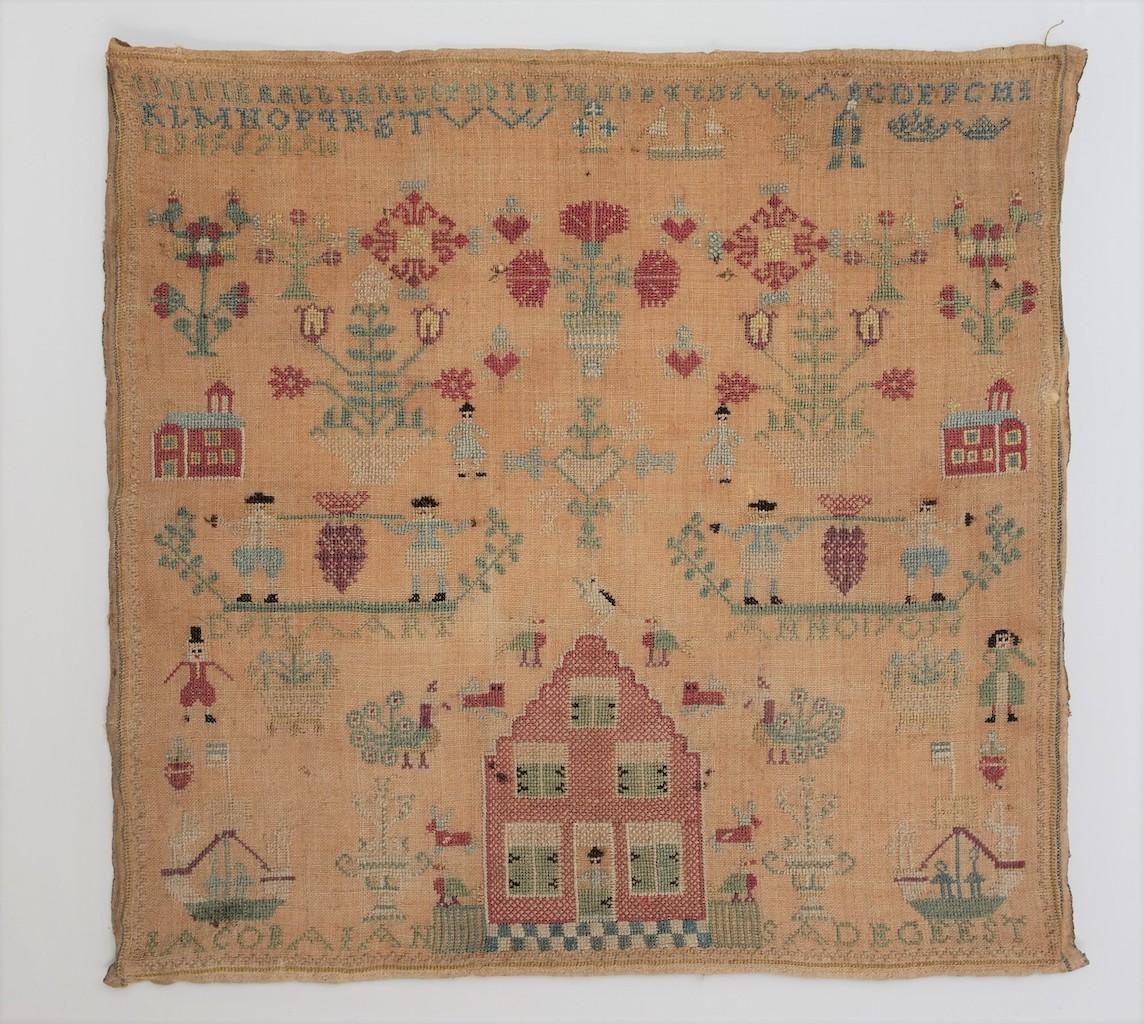
Haute Bordure: Catalogue to the exhibition with the same titel in the Fries Museum, Leeuwarden, the Netherlands (2021).Haute Bordure: Catalogue to the exhibition with the same titel in the Fries Museum, Leeuwarden, the Netherlands (2021).Willem and I have just returned from another visit to Friesland, both to see an embroidery exhibition at the Fries Museum, Leeuwarden, and to hear further details about Akke Scheepsma from the village of Schettens, who stitched a sampler in 1852. We were also privileged to go to the village of Pingjum in order to see an early Mennonite chapel that is ‘hidden’ behind a small private house (more below on all these subjects).

For over a year we have been unable to go anywhere, let alone see exhibitions, so it was with great relief when on Friday we went to the Frisian capital of Leeuwarden to see Haute Bordure, about 400 years of hand embroidery in the Netherlands, and especially that associated with Friesland. We were shown around by Eveline Holsappel, the curator of the exhibition.

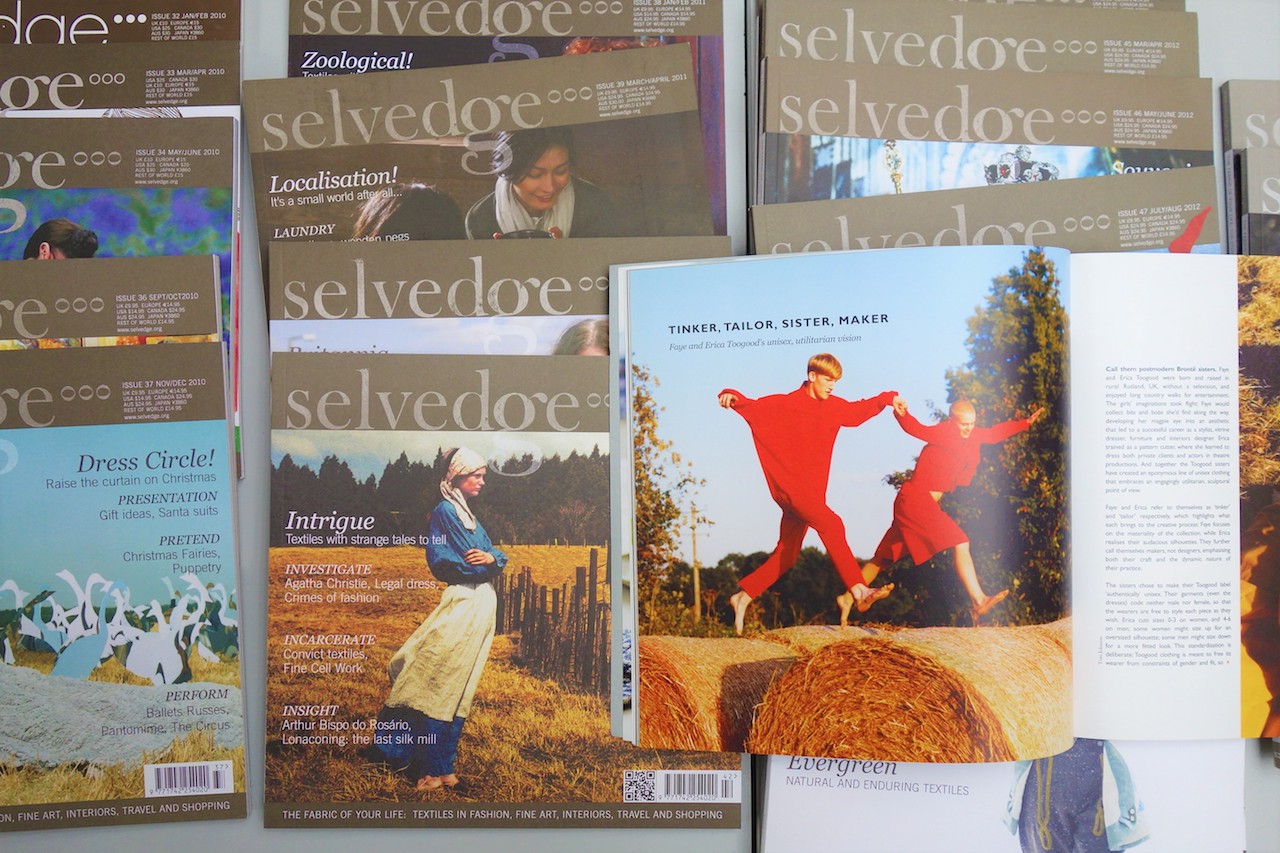
It is a lovely exhibition that is well-worth seeing. It shuts on the 18th July, so you have to be quick. You need to book in advance and we were told that many tickets are already booked. The exhibition includes examples of embroidery of various types that date from the early seventeenth century to ‘yesterday’, including regional, fashionable and royal forms for men and women. I have been asked to write a review of the exhibition for Selvedge, the London based textile journal. As soon as it is published I will let you know.

Zoek in TRC website

Contact

Boerhaavelaan 6
2334 EN Leiden.
Tel. +31 (0)6 28830428  
office@trcleiden.org

Het TRC is elke dag geopend tussen 10.00 en 15.00 uur.

facebook 2015 logo detail


instagram vernieuwt uiterlijk en logo


Bankrekening

NL39 INGB 0002 9823 59, t.a.v. Stichting Textile Research Centre.

Financiële giften

Het TRC is afhankelijk van project-financiering en privé-donaties. Al ons werk wordt verricht door vrijwilligers. Ter ondersteuning van de vele activiteiten van het TRC vragen wij U daarom om financiële steun:

Giften kunt U overmaken op bankrekeningnummer (IBAN) NL39 INGB 000 298 2359, t.n.v. Stichting Textile Research Centre. BIC code is: INGBNL2A

U kunt ook, heel simpel, indien u een iDEAL app heeft, de iDEAL-knop hieronder gebruiken en door een bepaald bedrag in te vullen: 


Omdat het TRC officieel is erkend als een Algemeen Nut Beogende Instelling (ANBI), en daarbij ook nog als een Culturele Instelling, zijn particuliere giften voor 125% aftrekbaar van de belasting, en voor bedrijven zelfs voor 150%. Voor meer informatie, klik hier