Two c. 1800 Dutch samplers: one story
Nelleke Ganzevoort wrote the following blog about a sampler in the TRC collection and a comparable example in the Rijksmuseum in Amsterdam.
In September 2020 the TRC in Leiden acquired an intriguing sampler (TRC 2020.3682). It is marked with numerous initials, but it still proved difficult, but not impossible, to identify the girl who made it. The sampler measures 30 x 29 cm and made with silk threads on a linen ground. It is not dated, but a late 18th century origin seemed likely, but now we know much more.
 Linen and silk sampler from the Netherlands, c. 1800 (TRC 2020.3682).
The linen is reasonably fine (16 threads/cm). The embroidery includes what look like lines of text, all around the edges, but by now nearly illegible: tiny stitches in badly faded threads. I took many photographs, enlarged them and puzzled it out, stitch by stitch. In the end the apparent texts were two alphabets and two lines of initials, some of them in cartouches. Many of the initials are joined together, which makes them difficult to read. The embroidery also includes lines of crowns and other symbols, along the four edges. Most of the embroidery is worked in cross stitch, but the initials without cartouches are worked in square eyelets.
By coincidence, I came across a sampler in the Rijksmuseum Amsterdam (BK-1959-142-A) that shows some clear correspondences with the TRC example. It includes initials and symbols along the edges, just like the TRC example. In fact, there are so many similarities that they were clearly made in the same tradition, perhaps in the same school, under the same teacher, or perhaps even from the same pattern book. There is at least one difference that also marks a similarity: the initials inside cartouches are worked in square eyelets, while those without cartouches are in cross stitch (exactly the opposite from the Leiden TRC example).
The Rijksmuseum notes provide further information about this sampler: it was made bij A.C. van Duuren. There is actually a darning sampler, also in the Rijksmuseum collection, with the name of A.C. van Duuren written in full (BK-1959-142-B). I suggest both names refer to the same person.
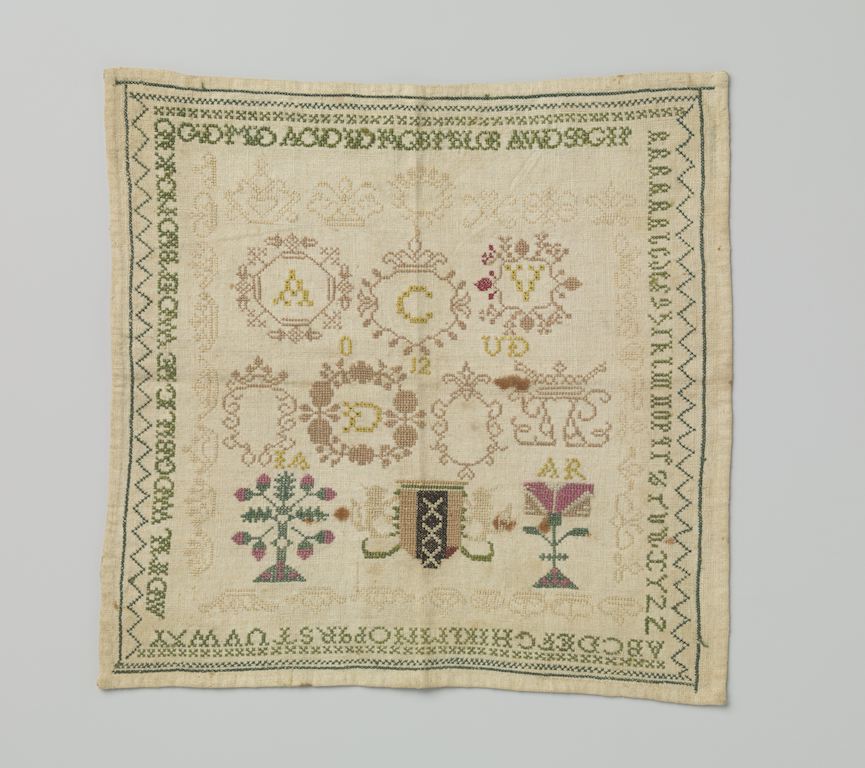 Sampler worked by A.C. van Duuren c. 1805/1806 (Rijksmuseum Amsterdam, 1959 142 A).
The initials ACVD in a cartouche of the Rijksmuseum sampler obviously refers to this person. The rows of smaller initials start with AvD and IMvL, and I guessed these were her parents. Searching the archives for a woman named A.C. van Duuren (Dueren, Duren) with a father called A. van Duuren soon helped me to her full name: Adriana Cornelia van Dueren, baptized 17-11-1793 in Leiden. Her parents were Abraham/Abram van Duuren/Dueren en Joanna/Johanna Maria van Loon.
Other initials in the Rijksmuseum sampler refer to her grandfather Willem van Duuren (WvD), her grandmother Grietje van Belle (GvB), her maternal grandfather Isaac van Loon (IvL), her eldest brother Willem van Duuren (WvD), and his wife Maria Elisabeth Broekkerken (EMB). Other initials include IvD (for her sisters Johanna and Jacoba and/or her brother Isaac), GvD (for sister Grietje and/or brother Gerardus), and MvD (for sister Maria). Adriana was married to Abraham Theodorus Beausar, a vicar, and died in 1869 in Willemstad, aged 75.
 Linen and silk sampler from the Netherlands, c. 1800 (TRC 2020.3682), with the initials CHD.The TRC sampler has large initials AMHD, in eyelets (but without cartouches as is the case with the Amsterdam example), which clearly refer to the maker, and several cartouches with the initials CHD, ICVB, CHD with an i underneath it, AVH, and in the corner AD. I assume CHD to be the father. Because both have the combination HD, and because these letters are so often paired in this sampler, I assume both to belong to the surname, the first half beginning with H and the second half with D. The mother could be ICVB, AVH or AD.
It took me some time to identify the girl. AMHD is Aletta Margareta Hoogendorp (or Hogendorp), born 27-05-1790 in Haarlem. Her parents were Cornelis Hoogendorp (CHD) and Johanna Christina Valbracht (ICVB). Other large initials refer to her paternal grandparents, Cornelis Hoogendorp (CHD) and Alida Double (AD) and her stepmother Ariaantje/Ariana van Hulst. Her mother’s parents may be AMVB and HP, in the rows of smaller initials, but I could not find their names in the archives.
Date
The samplers are not dated, but both girls embroidered their age. Adriana van Dueren was twelve years old (OUDT 12 IAAR) when she made her sampler. As she was born in 1793, this must have been in 1805 or 1806. Aletta Hoogendorp was born in 1790 and she made her sampler when she was nine years old, in 1799 or 1800. The place where they made them must have been in Holland: Adriana was from Leiden, Aletta from Haarlem. Adriana’s sampler shows the coat of arms of the city of Amsterdam, but the link between the girl and Amsterdam remains unclear.
I am not clear about the social status of the two families. Cornelis Hoogendorp was a country policeman (a ‘veldwachter’), Aletta married a working man (a ‘werkman’) and there were cobblers and carpenters in the family, but one of her father’s brothers was a vicar. Abraham van Dueren was a baker, but one of his sons went to university and Adriana married a vicar. Anyway, there must have been money to pay for schooling.
Motifs
 Detail of linen and silk sampler from the Netherlands, c. 1800 (TRC 2020.3682).
 Chart of detail of sampler TRC 2020.3682. Click on illustration for a PdF file.
Adriana’s sampler, in the Rijksmuseum, has many crowns and cartouches, the Amsterdam coat of arms and two trees. Aletta’s sampler is more interesting. In the first place, there are two butterflies. They appear to be identical, but I worked out the pattern and found many small differences. Maybe the girl was inexperienced at pattern reading, or maybe she did not have a pattern. Perhaps the butterfly was just drawn or stamped on the linen?
 Detail of linen and silk sampler from the Netherlands, c. 1800 (TRC 2020.3682).
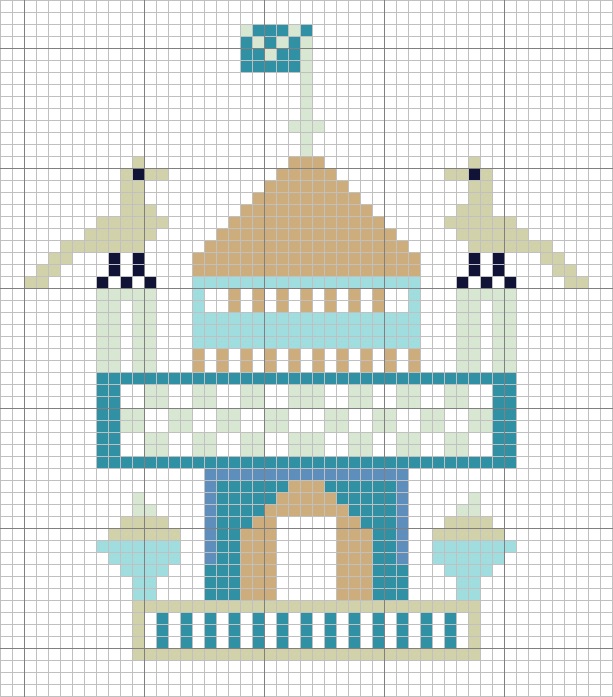 Chart of detail of sampler TRC 2020.3682. Click on illustration for a PdF file.
And then there are those two buildings: Is it a house, a church, a castle, a large gate, or simply an ornate dovecote? The chequered area in the middle suggests a balcony. And the white constructions (?) on which the birds are sitting: are there towers? Chimneys? I have no idea.
I tend to think there must be more samplers of this type around. If you have seen them, please tell us! Knowing more of them may make it possible to find out where they were made.
Nelleke Ganzevoort, 10 May 2021