• F3
  • F2
  • F4
  • F1

Costume print, France, from 'Costumes de différents pays' (c. 1797), by Jacques Grasset de Saint-Sauveur (1757-1810) (TRC 2023.0004).Costume print, France, from 'Costumes de différents pays' (c. 1797), by Jacques Grasset de Saint-Sauveur (1757-1810) (TRC 2023.0004).Over the last few months the TRC has acquired a number of antique prints that will be used to illustrate various mini- exhibitions (actual and digital) as well as publications (notably the Bloomsbury World Encyclopedia of Embroidery), as well as lectures and workshops on the themes of textiles, their production and use.

One of the late 18th century prints (TRC 2023.0004), for example, depicts a woman knitting with four knitting needles, while a cat plays with a ball of knitting yarn and a dog and a parrot look on. The print comes from Costumes de différents pays by the French encyclopaedist Jacques Grasset de Saint-Sauveur (1757-1810).

Another group of prints depict various trades in late 17th century Amsterdam from the famous book by Jan Luyken (1649-1712) and his son Casper (1672-1708), called Spiegel van het Menselyk Bedryf (1694, Amsterdam).

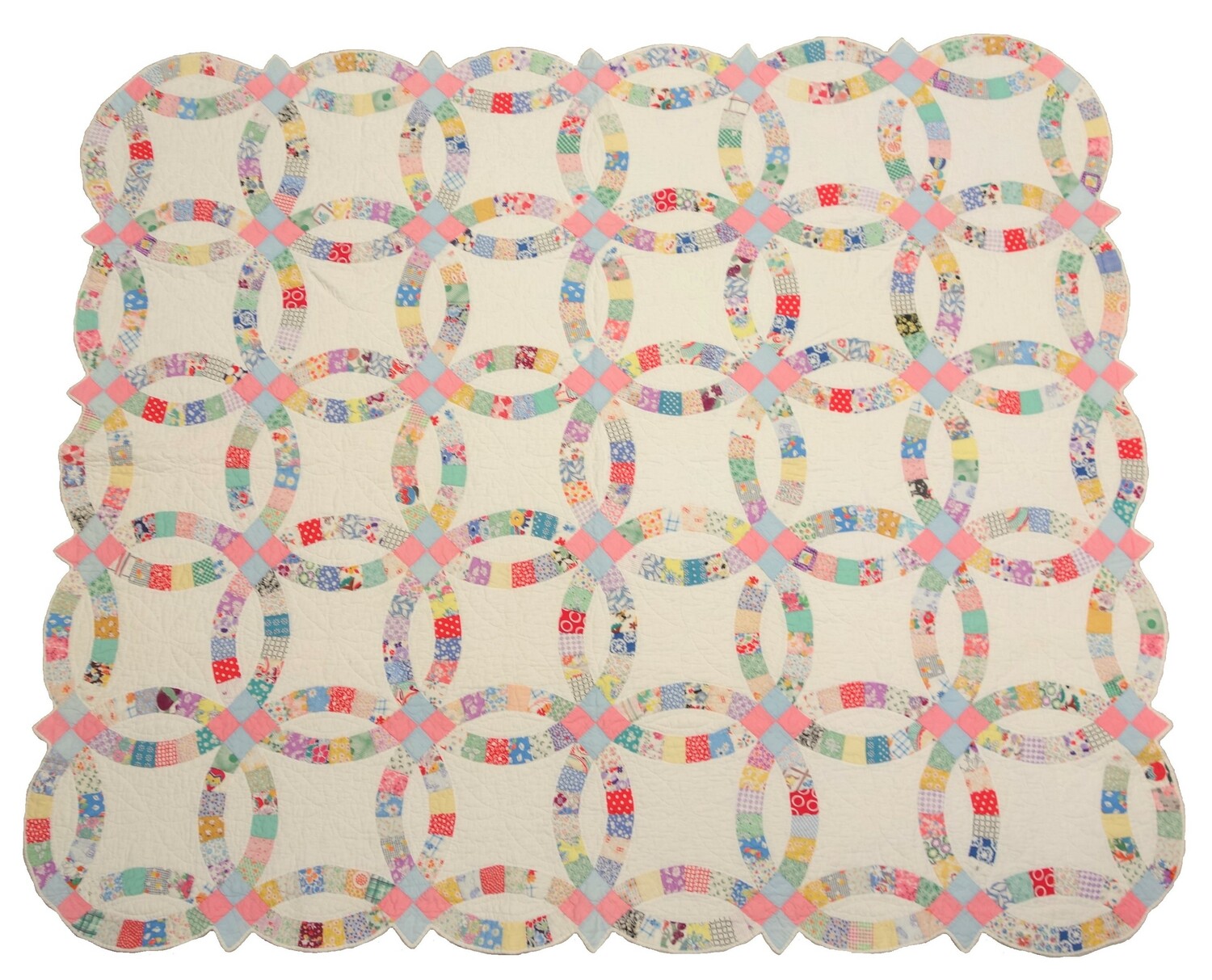
Following donations of another forty quilts to the TRC last year from David and Bonnie Naifeh Smith of Arizona and Sherry Cook of Seattle, I have now finished documenting them and they have been added to the Quilt Index website (see a previous blog of 16 August 2021). The Quilt Index (Michigan University) is an online depository of thousands of quilts from collections all over the USA and they have been expanding their remit to include collections in Europe and further afield, such as those of the TRC.

We now have a total of 152 quilts documented on their site – these can be accessed via quilt index.org and the TRC page can be found under Museums. A few highlights from the new quilts are illustrated below;

A child’s quilt embroidered with baby animals including rabbits, chickens, kittens and puppies from about the 1930’s (TRC 2022.1147).A child’s quilt embroidered with baby animals including rabbits, chickens, kittens and puppies from about the 1930’s (TRC 2022.1147).

Kebaya from East Sulawesi, Indonesia, c. 1946, made from bark bast cloth (TRC 2018.0042).Kebaya from East Sulawesi, Indonesia, c. 1946, made from bark bast cloth (TRC 2018.0042).At the end of 2022 Brunei, Indonesia, Malaysia, Singapore and Thailand, together nominated the kebaya, a woman’s blouse worn in many parts of Southeast Asia, for the UNESCO intangible cultural heritage list. The results should be heard shortly.

At first glance, you may wonder why should an object you touch be classed as intangible cultural heritage? Such a designation usually applies to music or folk stories, rather than a physical item. However, the nomination is more about the history behind the garment and how it has grown in importance in various diverse countries, rather than about an individual object.

For this blog I thought it might be interesting to add two more stories to the kebaya mix.

Hand embroidered postcard from Spain, with a scene from Valencia, mid-20th century (TRC 2019.2141).Hand embroidered postcard from Spain, with a scene from Valencia, mid-20th century (TRC 2019.2141).During the twentieth century, various forms of embroidered postcards were popular, notably the so-called hand embroidered postcards associated with the First World War (1914-1918). These are in fact machine embroidered (see the TRC online exhibition Silk embroidered postcards from the First World War).

But there were also postcards that were partially or entirely worked in hand embroidery. These come in two main forms, namely those relating to different countries which often have various specific forms of national dress, or general scenes of men and women, such as flamenco dancers.

Secondly, but not as common, are hand embroidered postcards depicting the Virgin Mary or a saint, artistic scenes with items such as fans and flowers, or fantasy images, such as children skating or sledging in winter scenes.


A Karen women in northern Thailand, along the border with Myanmar/Burma. Photograph by Dries Touw, 1965.A Karen women in northern Thailand, along the border with Myanmar/Burma. Photograph by Dries Touw, 1965.

Skirt made from a hand woven, hand dyed (ikat), and hand embroidered cloth. Purchased in 1965 in Thailand from among the Karen (TRC 2023.0189).Skirt made from a hand woven, hand dyed (ikat), and hand embroidered cloth. Purchased in 1965 in Thailand from among the Karen (TRC 2023.0189).A few weeks ago we were approached by Ria Snoek, Leiderdorp, about an outfit for a married Karen woman living in Thailand, which was originally acquired by her husband, Dries Touw (1935-2021), a bryologist (a specialist in mosses).

The Karen are an indigenous ethnic group from eastern Myanmar (Burma) and western Thailand. A complete outfit is always welcome, but details emerged that make the story of this donation even more interesting.

The TRC recently acquired a small, linen and cotton sampler (TRC 2023.0185), 31 x 31 cm in size, which mentions the name of D.W. Kolman, aged 9, and the year 1867. The sampler came as part of a larger collection of textiles that were donated by a member of the Dekker family. She also kindly gave us some background infomation about the collection.

A Dutch sampler worked by D.W. Kolman aged nine, in 1867 (TRC 2023.0185).A Dutch sampler worked by D.W. Kolman aged nine, in 1867 (TRC 2023.0185).

Painting by the Portuguese artist Samão César Dórdio Gomes (1890-1976), showing two women embroidering the famous Arraiolos carpets. Photograph by the author.Painting by the Portuguese artist Samão César Dórdio Gomes (1890-1976), showing two women embroidering the famous Arraiolos carpets. Photograph by the author.Various volunteers of the TRC have just been to Lisbon, Portugal (thanks to Erasmus+ funding) for a three-day workshop on the role and position of museums and other cultural institutions in society. My TRC colleagues left on Monday, but I stayed on for an extra day to go to Arraiolos, a small town east of Lisbon famous for its textiles, in particular its hand-embroidered carpets.

Arraiolos, Portugal.Arraiolos, Portugal.Last Tuesday, we  had a busy and very interesting day at the TRC, and I suspect we are going to have many more of these!

We have been host to a group from Portugal who are setting up a textile institute in Arraiolos, a city which lies about one hour drive from Lisbon, Portugal. The visitors were Filipe Rocha da Silva (artist), Cristina Maria Barrocas Dias (chemist, University of Évora), Rui Lobo, director of the Centro Interpretativo do Tapete de Arraiolos (CITA), and Silvia Pinto, the mayor of Arraiolos. It was a group with deliberately diverse backgrounds, all of whom are pushing to bring back textiles to the historic town of Arraiolos.

More specifically, they are particularly interested in the famous embroidered carpets (Tapete de Arraiolos) from the town that have been made there for over five hundred years. In the 20th century the production of these floor coverings just about died out and there is now a movement to bring them back, both as historic items and in a new (commercially viable) form. In fact, Rui Lobo is writing the entry on the Arraiolas embroidered floor coverings in volume 4 of the Bloomsbury World Encyclopedia of Embroidery, written and edited under the aegis of the TRC.

Zoek in TRC website

Contact

Boerhaavelaan 6
2334 EN Leiden.
Tel. +31 (0)6 28830428  
office@trcleiden.org

Het TRC is elke dag geopend tussen 10.00 en 15.00 uur.

facebook 2015 logo detail


instagram vernieuwt uiterlijk en logo


Bankrekening

NL39 INGB 0002 9823 59, t.a.v. Stichting Textile Research Centre.

Financiële giften

Het TRC is afhankelijk van project-financiering en privé-donaties. Al ons werk wordt verricht door vrijwilligers. Ter ondersteuning van de vele activiteiten van het TRC vragen wij U daarom om financiële steun:

Giften kunt U overmaken op bankrekeningnummer (IBAN) NL39 INGB 000 298 2359, t.n.v. Stichting Textile Research Centre. BIC code is: INGBNL2A

U kunt ook, heel simpel, indien u een iDEAL app heeft, de iDEAL-knop hieronder gebruiken en door een bepaald bedrag in te vullen: 


Omdat het TRC officieel is erkend als een Algemeen Nut Beogende Instelling (ANBI), en daarbij ook nog als een Culturele Instelling, zijn particuliere giften voor 125% aftrekbaar van de belasting, en voor bedrijven zelfs voor 150%. Voor meer informatie, klik hier