• F4
  • F3
  • F1
  • F2

Jacket made of reed and cotton, China, 20th century (TRC 2023.2071).Jacket made of reed and cotton, China, 20th century (TRC 2023.2071).It's been an incredibly busy time at the TRC! So what's new, you may ask, it is often busy at the TRC, but this is more so than normal!

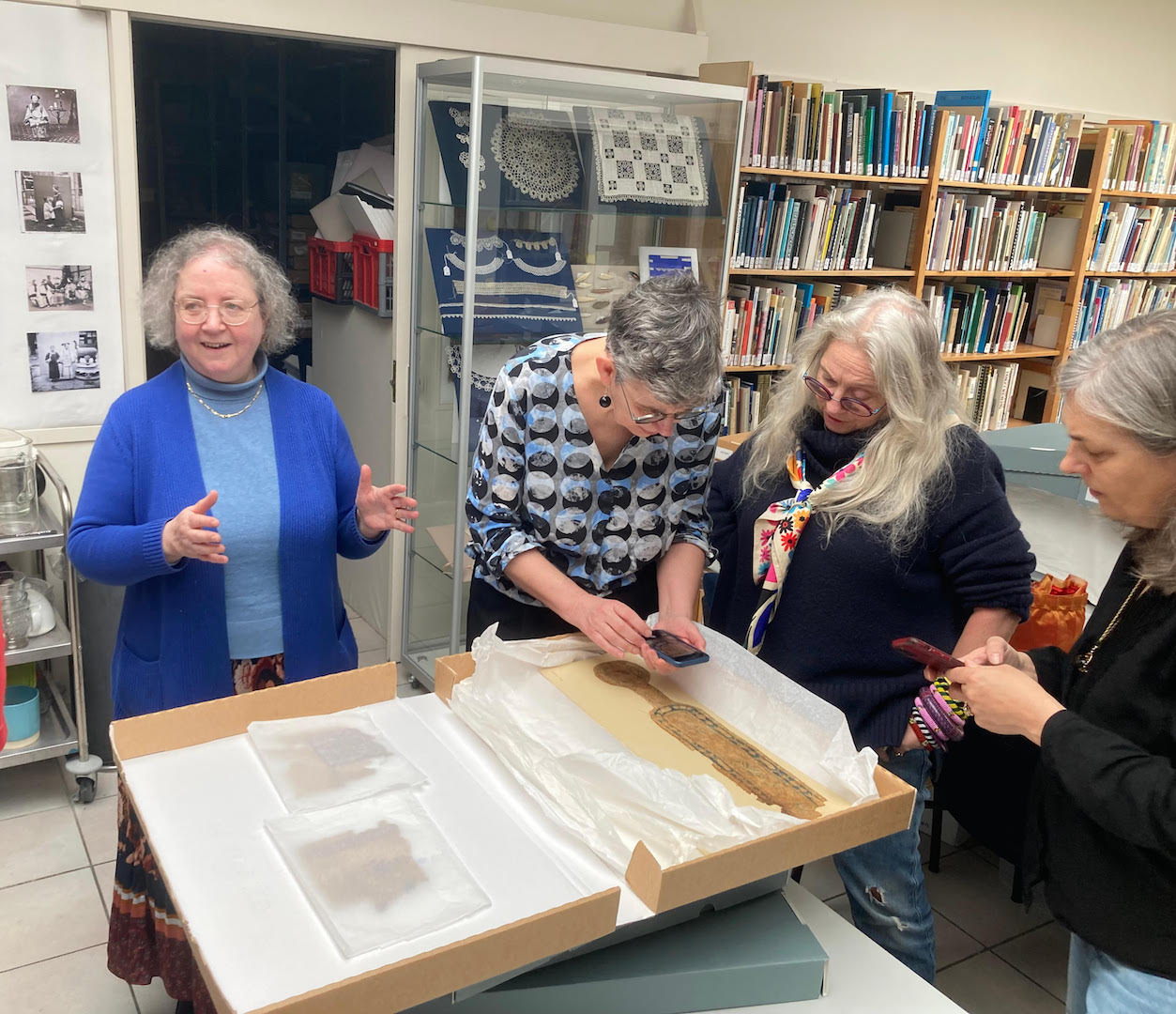
A few weeks ago, Quirina Vreeburg, from Haarlem, emailed saying she had two more boxes of Chinese textiles and garments for us. Quirina is slowly giving the TRC her collection of Chinese items that formed a small, private museum and lecturing collection (see earlier blog).

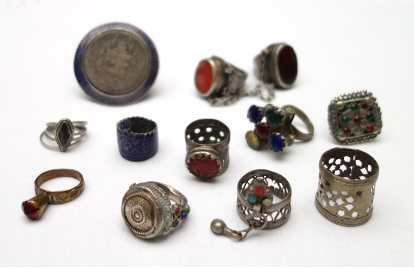
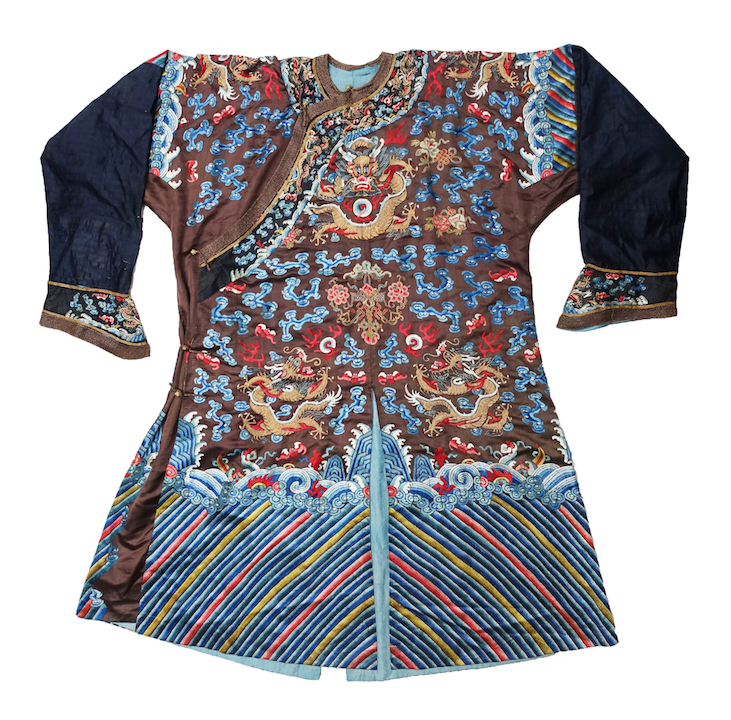
There are 67 items in the current selection, including gowns (Han and Manchu), single wrap-around skirts and double skirts, some amazingly embroidered jackets, as well as a jacket made up of small pieces of reed strung together to form a diamond net (TRC 2023.2071). There are also various embroidered panels from jackets, skirts, etc. The donation includes a pair of mourning lotus shoes in white, and two pairs of nineteenth century glasses with articulated side arms. There is a lovely headband decorated with panels of kingfisher feathers (TRC 2023.2074). And let us not forget an embroidered panel that looks like a stylised owl (TRC 2023.2078), but is it actually an owl?

(Naoko Kikuchi, 29 October 2023). Last summer I visited the city of Hirosaki, in the Tsukaru district, in northern Japan. This place is the home of kogin zashi, or simply called kogin, one of the major sashiko forms of quilting. The word kogin means 'small cloth' and zashi means 'stitches'.  Kogin stitches are worked horizontally, mostly by counting the odd number of warp threads, while sashiko stitches could run in any direction. In Hirosaki, I learned how local people are trying hard to preserve this tradition.

Cotton cushion cover, kogin-zashi, made by Misao Kimura, late 20th century, Japan (TRC 2021.1274).Cotton cushion cover, kogin-zashi, made by Misao Kimura, late 20th century, Japan (TRC 2021.1274).

Photo: TRC volunteer Shelley Anderson holding a copy of the TRC blog inside the National Silk Museum, USA. Photo by Francoise Pottier.Photo: TRC volunteer Shelley Anderson holding a copy of the TRC blog inside the National Silk Museum, USA. Photo by Francoise Pottier.It was a very pleasant surprise to learn recently just how far the TRC’s blogs can reach. I was at the National Silk Art Museum in Weston, Missouri (US). I had first visited the Museum in 2017, and written about the visit in a TRC (see 25 October 2017). It was a pleasant surprise to see, at the end of this second visit, a large copy of that TRC blog on the Museum’s wall.

When I told the Museum’s director, John Pottie, that I was a TRC volunteer and had written the blog, he thanked the TRC and said the blog piece had been “a real turning point for the Museum.” “Some upscale European magazine read the TRC’s blog and listed the Museum in its ‘Ten Museums to See in America’” Pettie said, which resulted in an upsurge of visitors and revenue.

A third of the Museum’s visitors now come from Europe. “We’ve been able to increase our collection to over 800 pieces, and double the objects we have on display to 400,“ he added. And all because of the TRC’s blog!

We have recently been given a linen bag with an embroidered panel (TRC 2023.1972) by Marijke Loots, after a previous visit to the TRC. The bag comes from her brother-in-law’s family, the Bergstra's. They originally come from Friesland, in the northern part of the Netherlands, but nobody is really sure where the bag comes from or how long it has been in the family. The bag and embroidery were examined at the TRC using an ADSM 302 Digital Microscope.

Detail of an embroidered  linen bag from the north of the Netherlands, dated 1815 (TRC 2023.1972).Detail of an embroidered linen bag from the north of the Netherlands, dated 1815 (TRC 2023.1972).

One of the things we enjoy at the TRC is linking an object to a person (or persons) and telling a little of their backgrounds. In the case of a recent donation there are two stories, a technical one about a piece of cloth, and the history of the people who once owned it. Both have a Leiden element.

Mantle piece cover made from mohair (trijp), the Netherlands, 20th century (TRC 2023.1928).Mantle piece cover made from mohair (trijp), the Netherlands, 20th century (TRC 2023.1928).

A few days ago Els Bonte, a long term friend and TRC volunteer (and born and bred in Leiden) who regularly donates items, came to the TRC with a length of dark brown velvet (TRC 2023.1928), decorated with a small geometric pattern in various shades of brown. It had been used by her grandparents, Arie Vijlbrief (1879-1970) and Engelina Magdalena de Jong (1878-1967), who were both born and brought up in Leiden (see below). The cloth was used as a mantle piece cover in their home at the Magdalena Moonsstraat, Leiden.

The cloth has a mohair pile on a cotton, plain weave ground. Mohair velvet was and still is used mainly for upholstery and comes in various qualities, from finely and compactly woven forms to loosely woven examples. In the Netherlands this type of velvet is generally known as velours d’Utrecht, Utrecht velours or Utrechter Plüsch, after the Dutch city of Utrecht that has been associated with the production, distribution and sale of velvet since at least the late seventeenth century.

Piece of mohair velvet, as used for the chairs in the House of Parliament, the Hague, the Netherlands (TRC 2018.2514).Piece of mohair velvet, as used for the chairs in the House of Parliament, the Hague, the Netherlands (TRC 2018.2514).

Winter is coming and I am thinking of blankets, and the warmth and comfort that woollen blankets provide. Blankets such as the beautiful hand woven red, black and white Dine (or Navajo) tapestry blanket (TRC 2022.1719) from the late 20th century, or the Nepali felted woollen blanket (TRC 2019.0543) from the TRC's Susi Dunsmore collection, that ingeniously folds into a hooded cape for rainy weather.

Late 20th century Navajo tapestry blanket, USA (TRC 2022.1719).Late 20th century Navajo tapestry blanket, USA (TRC 2022.1719).

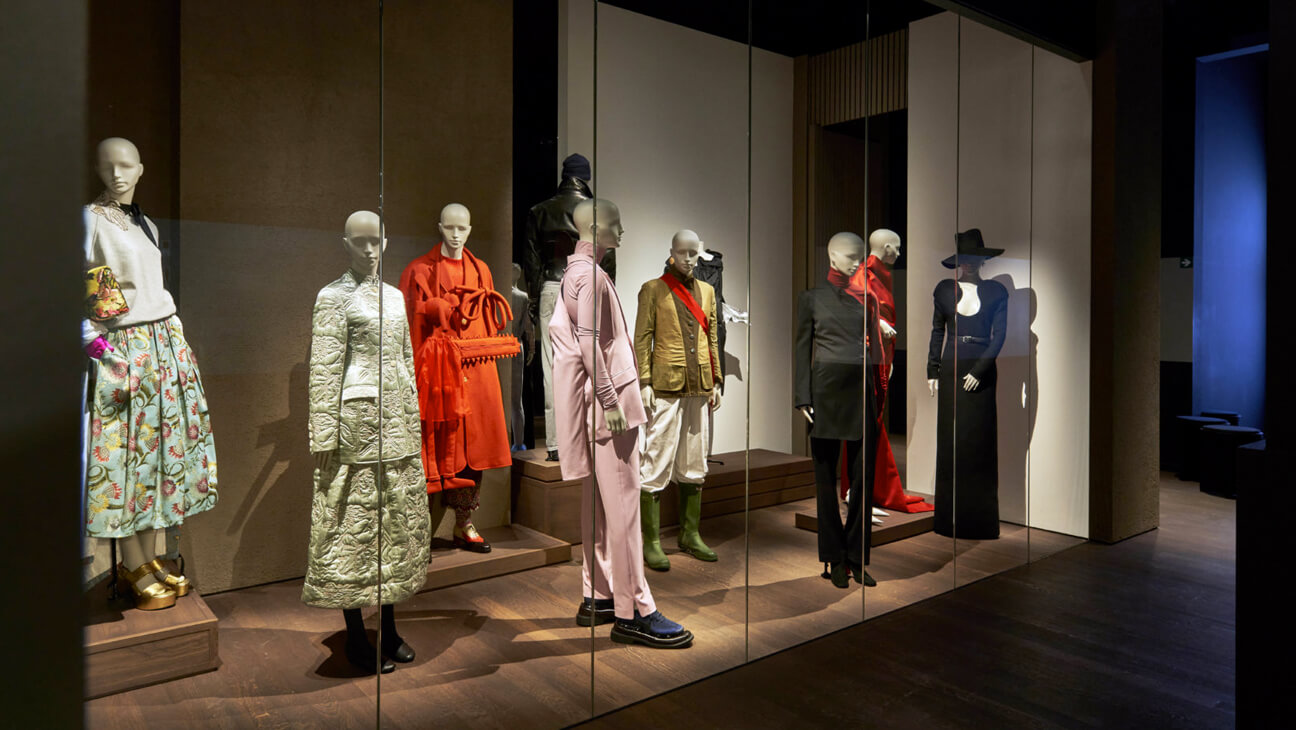
Last Thursday (28th September 2023) the TRC’s latest exhibition was officially opened. Gillian Vogelsang (director) welcomed everyone and was followed by the curator, Augusta de Gunzbourg. She explained the ideas behind the exhibition and how it was built up and added extra details about various outfits and garments.

Yvonne van Delft (left), wethouder Cultuur Gemeente Leiden, and Augusta de Gunzbourg (right), curator of the exhibition. Photograph by Maria Linkogle.Yvonne van Delft (left), wethouder Cultuur Gemeente Leiden, and Augusta de Gunzbourg (right), curator of the exhibition. Photograph by Maria Linkogle.

Augusta de Gunzbourg tells about 1920s fashion. Photograph by Maria Linkogle.Augusta de Gunzbourg tells about 1920s fashion. Photograph by Maria Linkogle.

The recent London Fashion Week (15-19 September 2023) included various young designers that caught the attention of the press. One of them was Kazna Asker from Sheffield, who has a Yemeni background and whose parents migrated to Britain many years ago.

Last week the BBC published an article about her work called: "London Fashion Week: The British Muslim designer trying to be the future."

Zoek in TRC website

Contact

Boerhaavelaan 6
2334 EN Leiden.
Tel. +31 (0)6 28830428  
office@trcleiden.org

Het TRC is elke dag geopend tussen 10.00 en 15.00 uur.

facebook 2015 logo detail


instagram vernieuwt uiterlijk en logo


Bankrekening

NL39 INGB 0002 9823 59, t.a.v. Stichting Textile Research Centre.

Financiële giften

Het TRC is afhankelijk van project-financiering en privé-donaties. Al ons werk wordt verricht door vrijwilligers. Ter ondersteuning van de vele activiteiten van het TRC vragen wij U daarom om financiële steun:

Giften kunt U overmaken op bankrekeningnummer (IBAN) NL39 INGB 000 298 2359, t.n.v. Stichting Textile Research Centre. BIC code is: INGBNL2A

U kunt ook, heel simpel, indien u een iDEAL app heeft, de iDEAL-knop hieronder gebruiken en door een bepaald bedrag in te vullen: 


Omdat het TRC officieel is erkend als een Algemeen Nut Beogende Instelling (ANBI), en daarbij ook nog als een Culturele Instelling, zijn particuliere giften voor 125% aftrekbaar van de belasting, en voor bedrijven zelfs voor 150%. Voor meer informatie, klik hier