


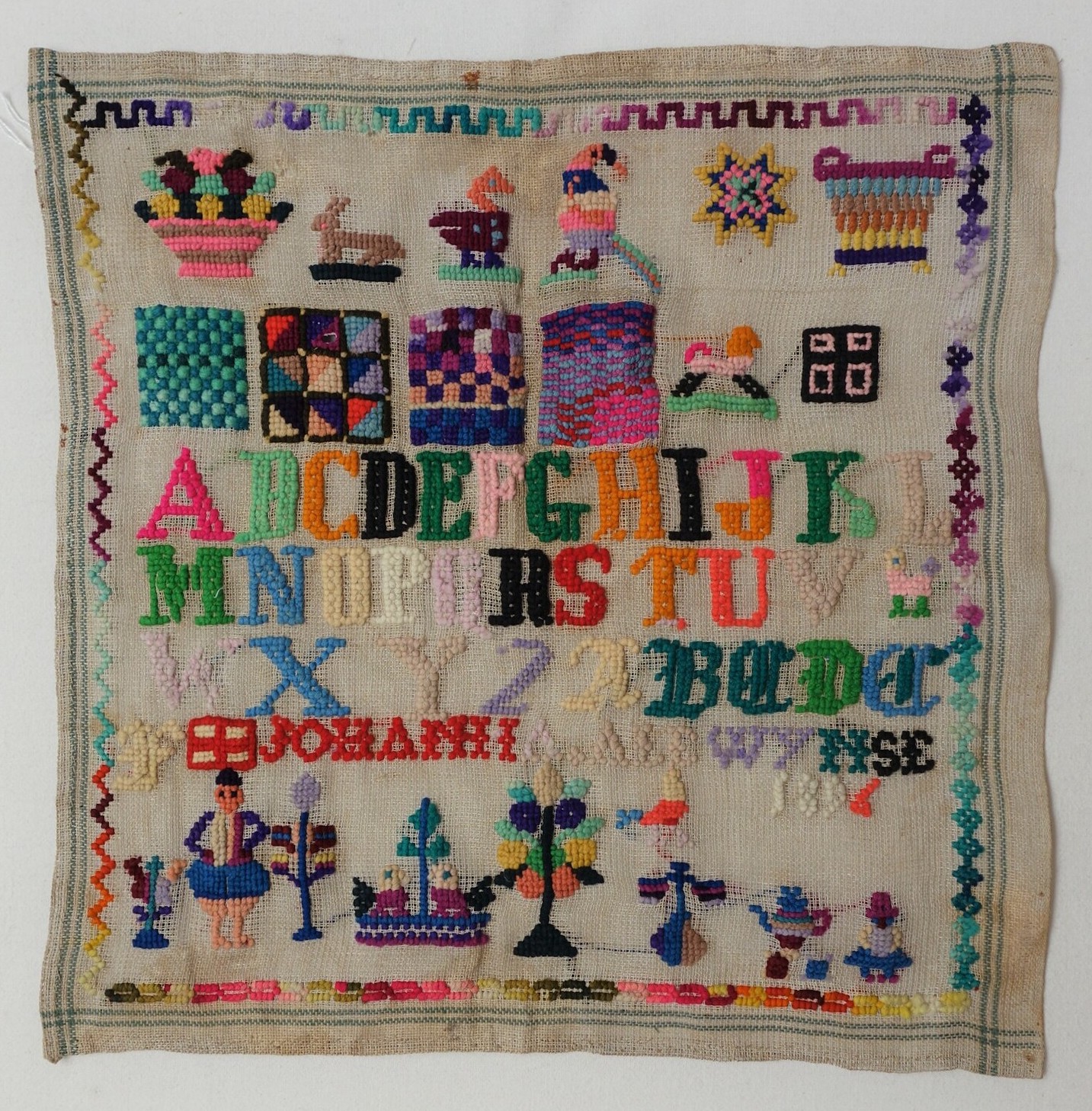
 Late 19th century sampler worked by Johanna Alewijnse, from Zeeland in The Netherlands (TRC 2018.2380).It is neither a great piece of art nor particular special. It is a sampler that was probably worked in the late nineteenth century by Johanna Alewijnse from Zeeland, The Netherlands (TRC 2018.2380). It's just school work, but with a surprise to those who turn it around.
The cloth measures 37 x 37 cm. It is made of a linen canvas, which was woven especially for teaching purposes, and it is embroidered with aniline dyed wool. The woollen embroidery thread is too thick for the (10-thread) mesh. The cross stitches form a thick mass, and the large squares are cushion-like and deform the fabric.
The layout is not very traditional. The sampler contains an alphabet and the beginning of a second, but there is no row of numbers. The letters are worked in the middle, rather than starting from the left. Above the alphabets is a row of squares with simple surface filling patterns, accompanied with other motifs, including baskets with flowers, animals, birds, and a star. Underneath the alphabets is a line of stylised flowers, a tree with paired birds, a male figure, and what appears to be a tea pot. All of this is framed by a simple border, which includes small geometric patterns in a seventeenth century style.
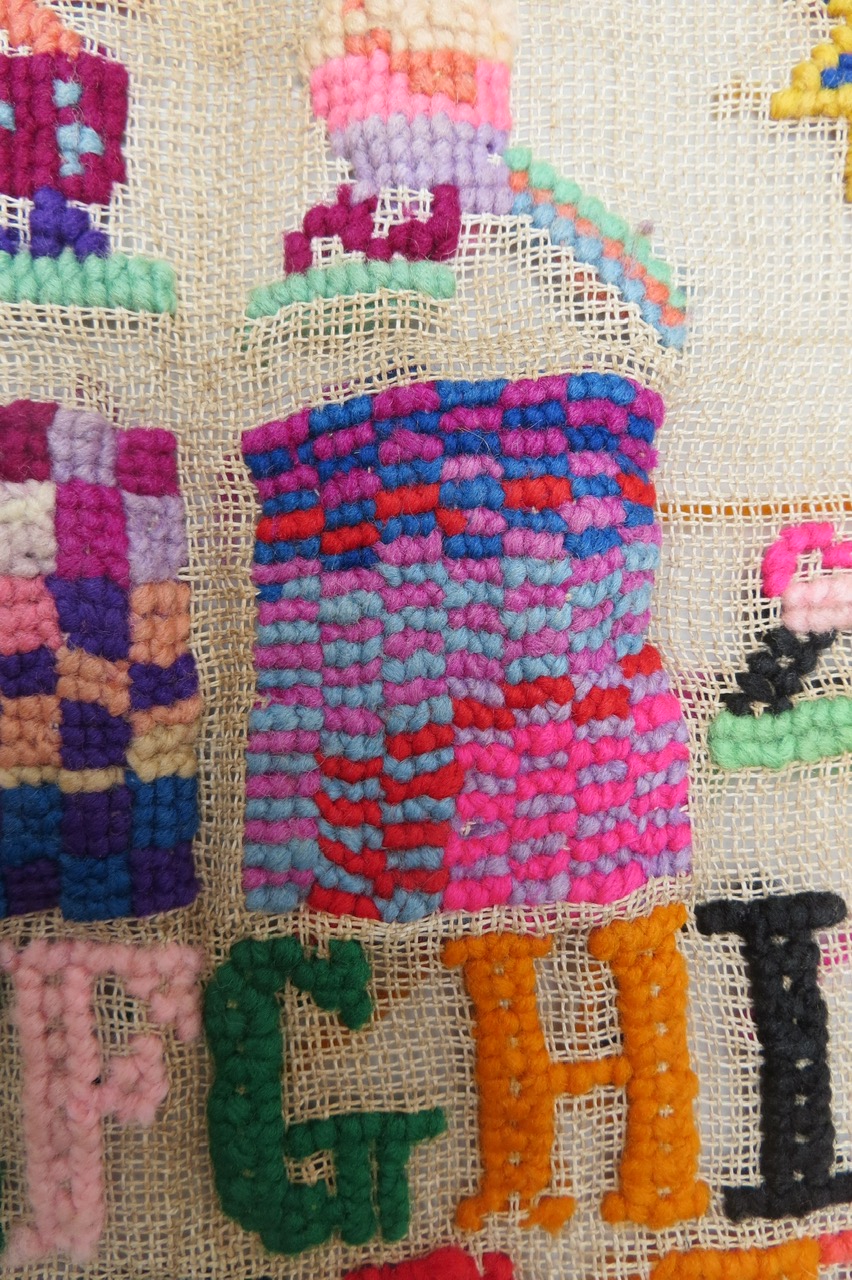 Detail of TRC 2018 2380.Most of the sampler is embroidered in cross stitch, but the left large square at the top is worked in star stitch (also known as double cross stitch). It certainly wasn't this girl's first work, at least not her first piece of embroidery. The alphabets are too complicated for that.
Underneath the second, unfinished alphabet is a name and a date.I first read the year as 1896, but it is probably 1894. The name is easier to read: Johanna Alewijnse. According to local archives, she was probably born on the 1st February 1880 in Sint Laurens, on the island of Walcheren in Zeeland, in the southwest of the Netherlands, as the daughter of Cornelis Alewijnse and Maatje van Tatenhove. Incidentally, there have been more persons with that name, and I am not sure I found them all.
If the identification is correct, Johanna would have been fourteen years old when she made the sampler. There have been many girls who made much more difficult embroideries at a much younger age, but it could be correct anyway. Johanna was the daughter of a day labourer, so she will have lacked an extensive education. Compulsory education did not yet exist, and the quality of education at schools for the poor was not always high.
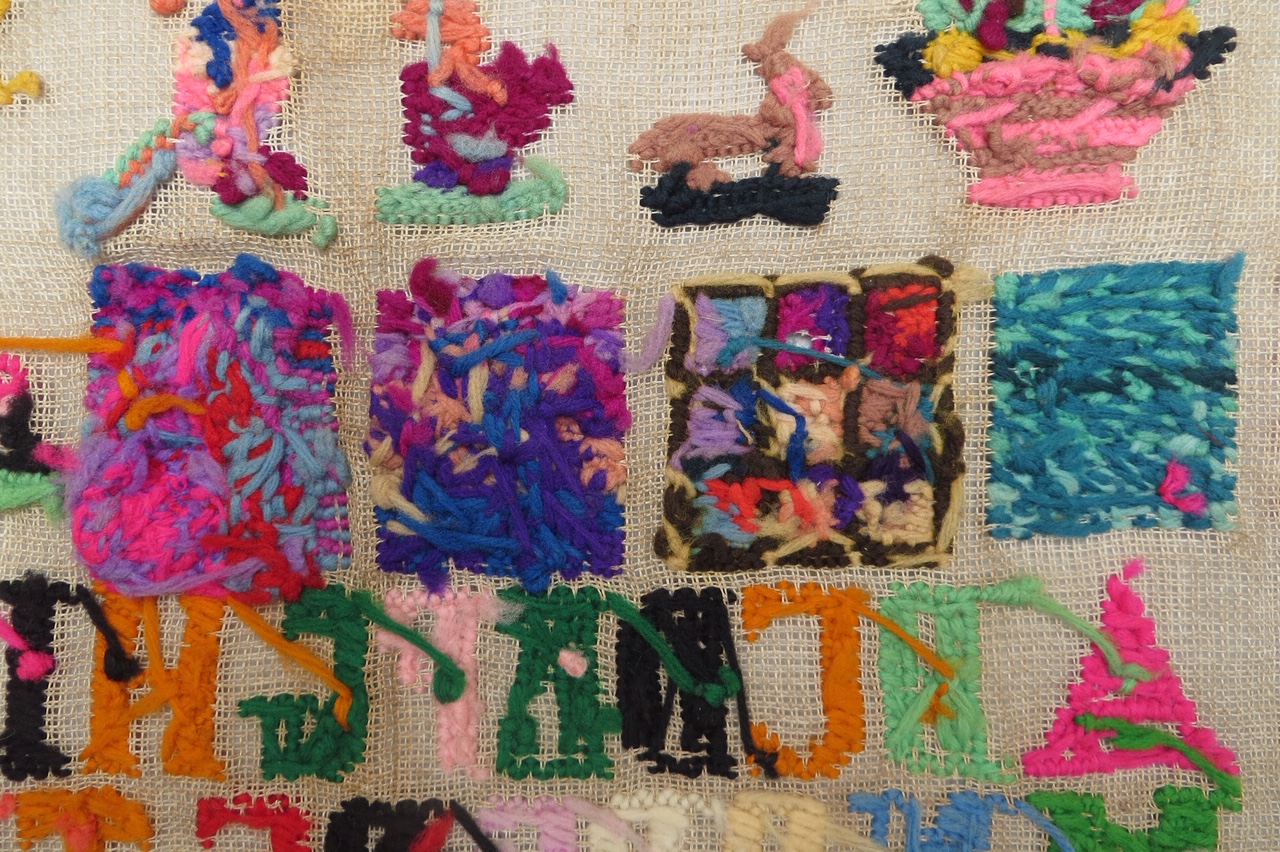 The back of sampler TRC 2018 2380.Johanna probably had to work from a young age, and she had to struggle for her education. Perhaps she earned the money herself for needlework lessons, in the village or in the nearby town of Midddelburg. Perhaps the local vicar's wife gave evening classes to promising young girls. We do not know. What we do know is that Johanna did not live long. She died on the 4th March 1912, aged 32, in Sint Laurens, without a stated profession and unmarried.
The sampler doesn't tell much about Johanna, except that she liked colour. So she was lucky that she lived in the days of aniline dyes, and she indulged herself. The result is colourful, but also very cheerful. You can imagine that she enjoyed the work.
The surprise is on the back. Johanna was not thrifty with the wool: there is even more yarn at the back than at the front. As a result, the embroidered patterns lose their shape and turn into abstract art. I would love to frame them in that way.
Nelleke Ganzevoort, 30th August 2020.


