


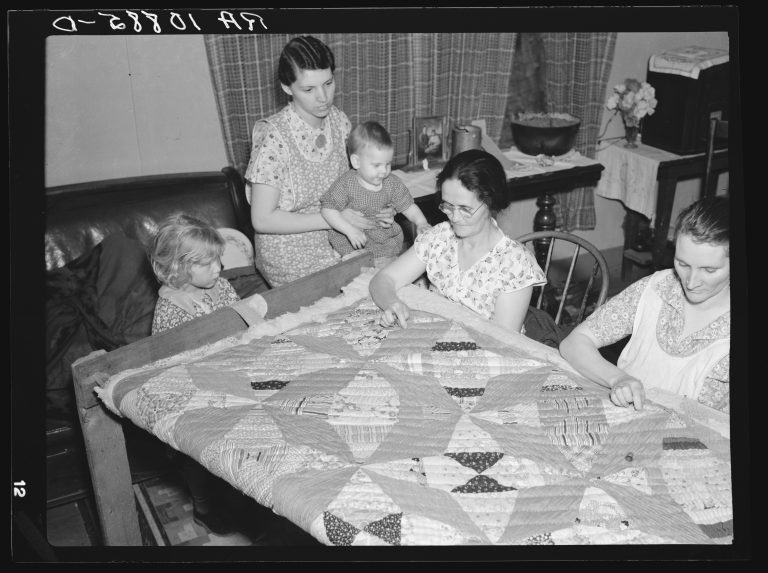
 Women working a quilt under the 1930s WPA Sewing Room Project (Lee LC USF34 010885 D 768x573).Last week the TRC took down its exhibition on American quilts. What became clear when organising and displaying the exhibition, is the importance that quilts have played in American history. A remarkable story is recounted by textile historian, Kyra Hicks, who tells about an Afro-American woman called Estella Weaver Nukes. She made a postage stamp quilt and presented it to President Roosevelt. TRC volunteer, Shelley Anderson, retells this fascinating story.
Before the US entered World War II, the country was struggling with massive unemployment and poverty. In an effort to provide jobs for millions of destitute Americans, President Franklin Delano Roosevelt (1882-1945) established the Works Projects Administration (WPA). The WPA hired jobless men to build roads, dams, schools and libraries.
The WPA also hired unemployed women, through its Sewing Room Projects, to produce clothing and bedding for distribution among poor Americans. By 1938 some 10,259 sewing rooms had been established in cities and towns across the country. Some involved hand sewers working in school basements, while others employed professional seamstresses to operate industrial machines in factory-like conditions. By the time the WPA ended in 1943, after unemployment fell sharply due to the war effort, the Sewing Room Projects had produced over 300 million garments, including fashionable dresses, men’s suits, winter coats, children’s clothes, hospital gowns, military uniforms—and quilts.
Estella Weaver Nukes (1888-1937) was an African-American housewife who lived in Marion, Indiana. Like many, she was able to feed her family thanks to the local Sewing Room Projects. She decided to make a special thank-you gift for President Roosevelt—a patchwork quilt. For one to two years she and other Marion Sewing Room Projects women worked on a bed-size Postage Stamp Quilt for the President.
Many Sewing Room Projects across the country were making patchwork quilts (along with hand-loomed rugs, rag dolls and other stuffed toys) from cotton scraps and off cuts. And the Postage Stamp design was popular at the time, involving a thousand or more tiny rectangular pieces, each no bigger than a postage stamp.
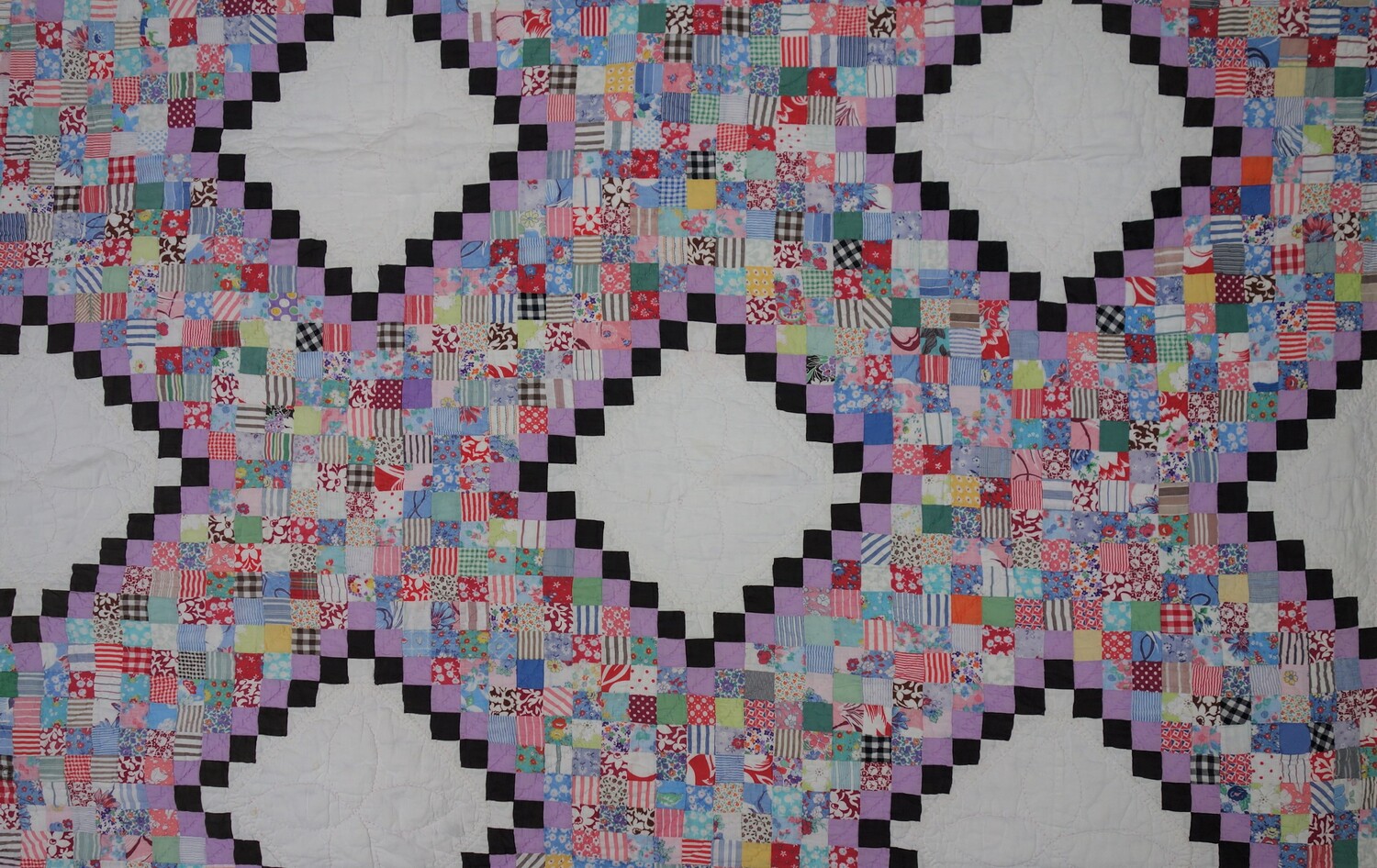 Detail of a mid-20th century postage stamp quilt from the USA (TRC 2017.4253).
Modern quilt historians, such as Kyra Hicks, who has written about Nukes and her gift to the President, wonder why she didn’t choose a more formal or regal design, like a Baltimore Album quilt. Hicks speculates that Nukes knew, like many other Americans, that President Roosevelt was an avid stamp collector. Nukes’ gift was displayed in a Marion department store, and at city hall, before it was sent to Washington, DC.
Her gift was reported in many newspapers, especially African-American media, around the country. It was not the first quilt gifted to President Roosevelt and First Lady Eleanor Roosevelt—the Franklin Delano Roosevelt Museum (NY) has nine quilt gifts in its collection. The American Museum in Bath (UK) has a Trip Around the World (a variation of the Postage Stamp) quilt that was given to the First Lady around 1939. Sadly, Estella Nukes’ quilt has disappeared—and with it, a piece of history.
Shelley Anderson, Saturday 29th August.


